AI
How Oracle Is Enabling Agentic Analytics
IntroductionIn my previous post, I looked at how agentic analytics is the natural progression of augmented analytics.If augmented analytics introduced AI assistance into the analytics experience, agentic analytics…
Introduction
In my previous post, I looked at how agentic analytics is the natural progression of augmented analytics.
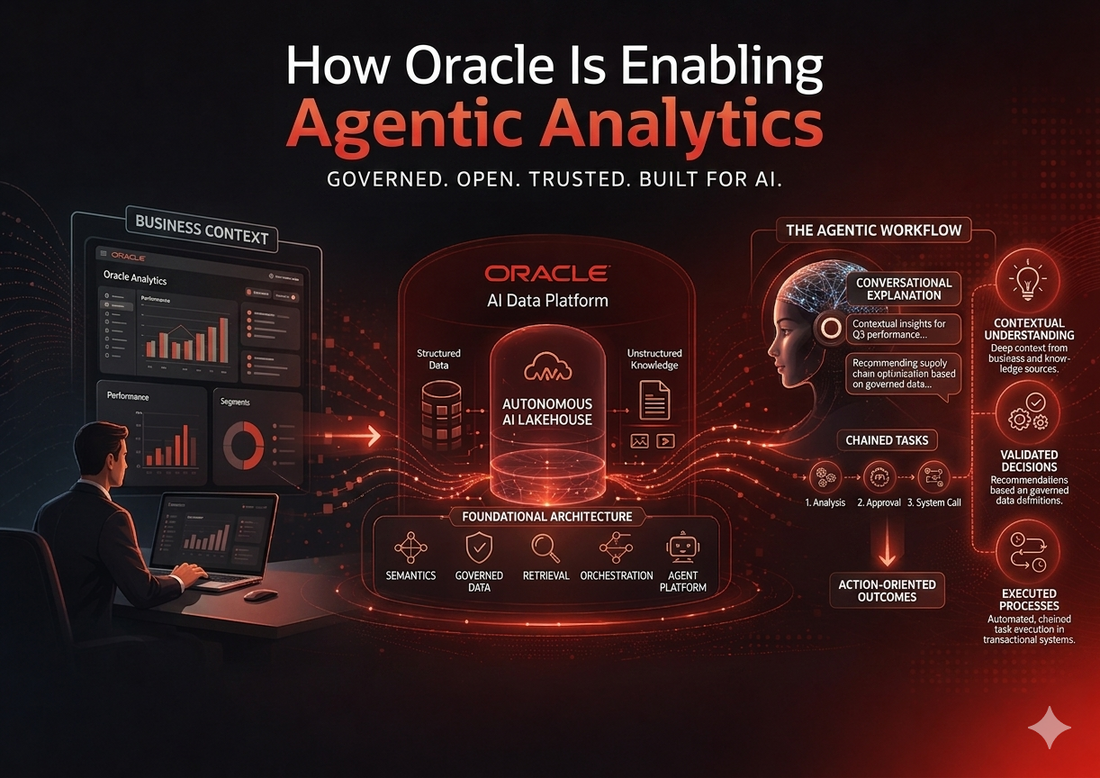
If augmented analytics introduced AI assistance into the analytics experience, agentic analytics extends that further through business context, governed definitions, runtime knowledge retrieval, chained tasks, conversational explanation and action-oriented outcomes.
The next question, then, is what this looks like in practice.
For me, Oracle is increasingly assembling many of the building blocks needed to enable agentic analytics. Not through a single feature, but through the combination of Oracle Analytics, Oracle AI Data Platform, Autonomous AI Lakehouse, agent platform capabilities and database-level governance to name a few.
That does not mean the journey is finished. But it does suggest that Oracle is putting in place the architecture needed to move analytics beyond static reporting and even AI-assisted insight discovery into something more contextual, guided and potentially action-oriented.
Agentic Analytics Needs More Than a Chatbot
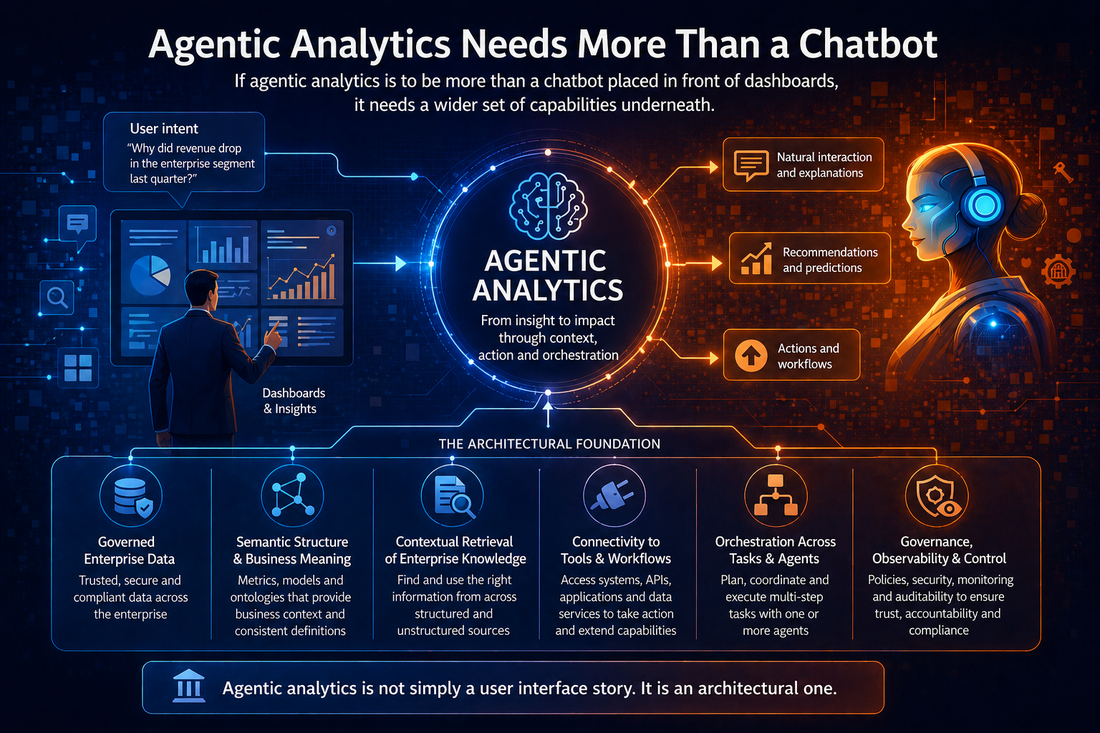
If agentic analytics is to be more than a chatbot placed in front of dashboards, it needs a wider set of capabilities underneath.
It needs:
- governed enterprise data
- semantic structure and business meaning
- contextual retrieval of enterprise knowledge
- connectivity to tools and workflows
- orchestration across tasks and agents
- governance, observability and control
This is why agentic analytics is not simply a user interface story. It is an architectural one.
Oracle Analytics Provides the Interaction Layer
Oracle Analytics already provides several of the capabilities that form part of this picture.
It brings together governed metrics, semantic models, dashboards, self-service exploration and AI-driven user experiences. Semantic models remain especially important here because they provide the governed definitions and business context that make analytics trustworthy.
The Oracle Analytics Cloud semantic modeller is central to this. It allows organisations to define logical business models, measures, hierarchies, joins, calculations, aliases, descriptions and access rules in a way that business users can consume consistently. That matters because AI features in OAC need more than access to tables and columns. They need business meaning.
As Oracle Analytics becomes more conversational and assistant-driven, those foundations become even more important. If analytics is going to interpret business intent and explain results in a meaningful way, it needs a stable semantic layer underneath. A well-designed semantic model can therefore improve the quality of AI-driven experiences by giving the platform clearer definitions, better context and a more reliable analytical structure to reason over.
In that sense, Oracle Analytics provides much of the user-facing interaction layer for agentic analytics.
Oracle AI Data Platform Provides the Broader Platform Layer
Oracle AI Data Platform extends that picture into the wider enterprise data and AI landscape.
It brings together structured and unstructured data, catalog capabilities, governed discovery, AI tooling, notebooks and an emerging agent platform story. That matters because agentic analytics needs access not only to trusted analytical data, but also to the documents, knowledge sources and broader platform services that can help ground and enrich results.
Oracle AI Data Platform is also positioned as a platform that unifies structured, unstructured, batch and real-time data across the enterprise. That broader platform view is important because agentic analytics depends on more than just curated dashboards. It depends on a governed data estate that AI-driven analytics can draw from more intelligently.
The March 2026 AIDP roadmap also makes the agentic AI direction much more explicit.
In the current roadmap view, Oracle calls out agents supported by OCI Generative AI models, tool types such as RAG, SQL and prompt, low-code agent flow creation, deployment to AI compute, a testing playground, observability and guardrails.
These already point towards a more complete agent development and runtime experience within AIDP.
The upcoming roadmap extends this further with multi-agent support, MCP client, server and tools, custom code tools, high-code agent development, MLOps and A2A.
For agentic analytics, those capabilities are important because they begin to cover the practical requirements of:
- building agents
- connecting them to tools
- supporting more advanced development patterns
- enabling collaboration between agents
- operating them in a governed and observable way
It is also worth noting that these are roadmap items, so timing and delivery remain subject to Oracle’s usual forward-looking safe harbour caveats.
Autonomous AI Lakehouse Helps Provide the Data Foundation
Within that broader story, Autonomous AI Lakehouse helps provide part of the underlying data foundation.
It adds a governed data and storage layer that can support both analytics and AI workloads, helping make enterprise data more accessible in a way that fits with the wider Oracle AI Data Platform architecture.
This matters because agentic analytics depends on more than interface-level intelligence. It also depends on having the right data foundation beneath it, one that can support trusted structured and unstructured data access at scale.
Agent Platform Capabilities Begin to Matter
The emergence of agentic analytics also depends on more explicit agent platform capabilities.
This is where the Oracle AI Data Platform Partner Summit was especially interesting. Oracle discussed Agent Studio, Agent Hub and Agent Registry as part of a broader direction towards building, exposing, orchestrating and governing AI agents.
That matters because agentic analytics is not just about generating a response. It increasingly involves chaining tasks together, retrieving the right context, invoking tools, coordinating actions and potentially handing work across systems or agents.
The more analytics becomes agentic, the more these platform capabilities begin to matter.
Governance Needs to Reach the Data Layer
One of the most important requirements for agentic analytics is governance.
If AI-driven analytics is going to interpret intent, retrieve knowledge, explain findings and support actions, then governance cannot be treated as an afterthought. It needs to remain enforceable all the way down to the data layer.
This is where Oracle’s broader governance story becomes relevant, including the emerging role of Deep Data Security in Oracle AI Database 26ai.
Deep Data Security is described by Oracle as a declarative, identity-aware access control system designed to simplify and modernise fine-grained authorisation directly in the database. That makes it particularly relevant to agentic AI because it points towards a model in which downstream services and AI-driven access paths can still be governed by centralised database-level policies.
For me, that is an important part of the story. Agentic analytics will only be credible in the enterprise if governance remains durable, auditable and enforceable beyond the front-end experience.
Bringing the Layers Together
Taken together, Oracle’s approach begins to look like this:
- Oracle Analytics provides the analytical interaction layer
- semantic models provide governed business meaning
- Oracle AI Data Platform provides the broader enterprise data and AI platform
- Autonomous AI Lakehouse helps provide the governed data foundation
- agent platform capabilities support orchestration, tools and actions
- database-level governance helps enforce durable control downstream
That does not yet amount to a finished end-state for every organisation. But it does show that Oracle is increasingly assembling the architecture needed to enable agentic analytics in practice.
Why This Matters
The value of this is not simply that Oracle has AI features across multiple products.
The more important point is that these components can start to work together.
Agentic analytics needs more than dashboards, and more than a natural language front end. It needs semantics, data foundations, retrieval, orchestration, tools and governance. Oracle’s current platform direction suggests that it is increasingly thinking about that fuller picture.
Conclusion
If agentic analytics is the next evolution of augmented analytics, then the enabling question becomes whether platforms can support that shift in a governed and enterprise-ready way.
For me, Oracle is increasingly showing that it can.
Not because one product alone solves the whole problem, but because Oracle Analytics, Oracle AI Data Platform, Autonomous AI Lakehouse, agent platform capabilities and database-level governance are beginning to form a more coherent foundation for analytics that is not just descriptive or exploratory, but more contextual, guided and action-oriented.