AI
The Shift from Augmented to Agentic Analytics
IntroductionAnalytics has never stood still.Over time, different modes of analytics have emerged to meet different business needs and different levels of user maturity. First came governed analytics, where trusted…
Introduction
Analytics has never stood still.
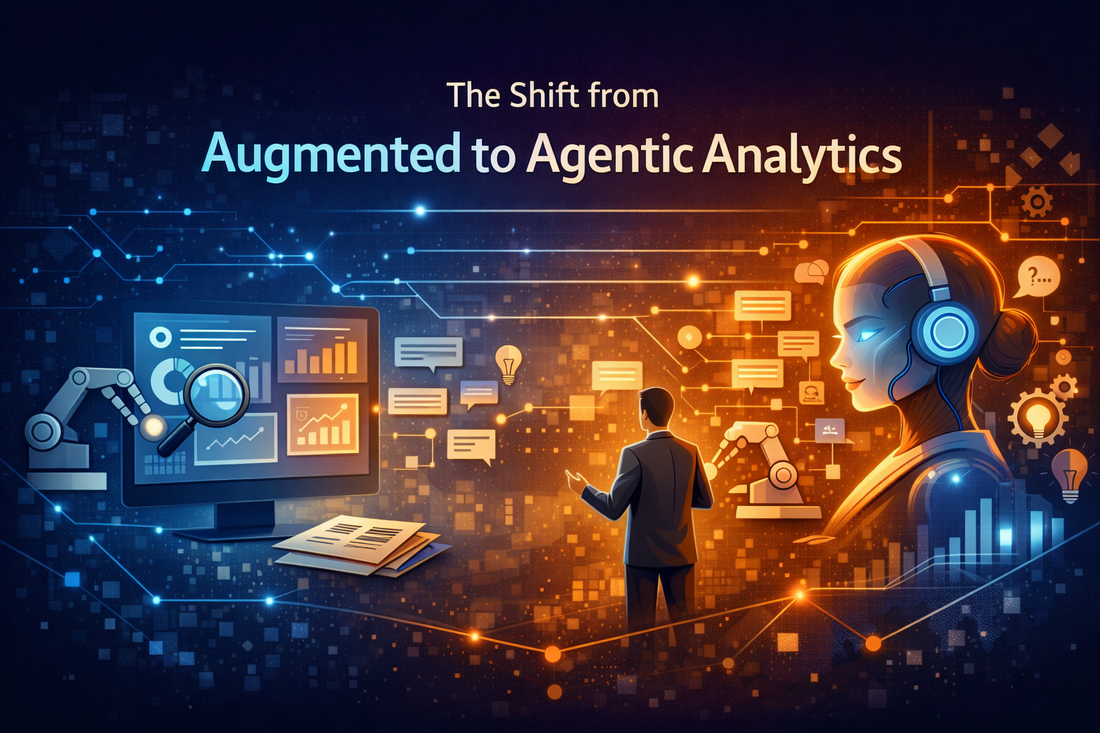
Over time, different modes of analytics have emerged to meet different business needs and different levels of user maturity. First came governed analytics, where trusted reporting and centrally managed definitions were the priority. Then came self-service analytics, where the focus shifted towards wider access, exploration and user-driven insight discovery.
More recently, analytics entered another phase: augmented analytics. This was the point at which AI and machine learning began to assist with activities such as pattern detection, insight surfacing, explanation and natural language generation and processing. In many ways, augmented analytics marked the beginning of AI becoming part of the analytics experience.
I think we are now seeing the next progression of that idea: agentic analytics.
For me, agentic analytics is not separate from augmented analytics but can be seen more as a natural evolution. If augmented analytics introduced AI assistance into the analytics workflow, agentic analytics extends that further by applying AI agents across more of the data-to-insight process, helping to orchestrate steps, interpret intent, retrieve context, explain findings and increasingly recommend or support actions.
This is not simply self-service analytics with a chatbot bolted on. Nor is it a replacement for the strands that came before it. Governed analytics still matters. Self-service analytics still matters. Augmented analytics still matters. But AI assistants and agents are beginning to create a further mode of interaction with analytics, one that is more conversational, context-aware and increasingly action-oriented.
Governed Analytics
Governed analytics was built around trust, consistency and control.
This was the world of centrally managed reporting, curated dashboards, semantic models, governed metrics and carefully controlled access to data. The emphasis was on ensuring that when people asked for revenue, margin, headcount or customer numbers, they were looking at the same definitions.
That model solved an important problem. It created confidence in enterprise reporting and gave organisations a stable analytical foundation.
Self-Service Analytics
Self-service analytics expanded the audience for data.
Instead of relying entirely on centrally built reports, business users were increasingly able to explore data for themselves, build their own dashboards and answer their own questions more directly.
This changed analytics significantly. It increased agility, broadened access to insight and reduced some of the bottlenecks associated with traditional BI delivery models.
At the same time, it introduced its own tensions around governance, consistency and control. That is why governed analytics did not disappear when self-service analytics arrived. The two strands have continued to coexist.
Augmented Analytics
Augmented analytics marked the point at which AI and machine learning began to play a more active role in the analytics experience.
Instead of simply presenting reports or dashboards, analytics platforms began to assist with activities such as pattern detection, insight surfacing, explanation, natural language interaction and automated visual suggestions.
This was an important shift because it moved analytics beyond static consumption and self-service exploration into a more assisted mode of working. The system was no longer just something users queried directly. It was beginning to participate more actively in helping users find and interpret insight.
In that sense, augmented analytics became the bridge between traditional analytics models and the more agentic capabilities now starting to emerge.
Why a New Strand Is Emerging
AI is now changing the way users interact with analytics once again.
Users are no longer limited to navigating dashboards, building visualisations or writing queries. Increasingly, they can ask questions conversationally, request explanations, explore follow-up questions and receive suggested next steps.
In some cases, AI can also retrieve relevant knowledge, explain business context, simulate scenarios, recommend actions or even interact with downstream tools and workflows.
That is a different interaction model from either governed analytics or self-service analytics.
It is not simply about giving users more charts. It is about allowing analytics systems to behave more like intelligent collaborators.
What Agentic Analytics is
For me, analytics becomes agentic when the platform can do more than simply return a report, render a chart or answer a natural language query.
Agentic analytics begins to emerge when the system can:
- interpret business intent rather than just keywords
- use governed definitions and business context
- retrieve supporting knowledge at runtime
- explain results conversationally
- chain together multiple analytical steps
- recommend next actions or scenarios to consider
- interact with downstream tools, systems or workflows
This is where analytics begins to move from static consumption and even self-service exploration towards a more active, guided and potentially action-oriented experience.
"Agentic analytics represents the evolution of augmented analytics by applying AI agents... for data analysis. It involves software used for the process of data analysis that applies AI agents across the data-to-insight workflow, orchestrating tasks semi-autonomously or autonomously toward stated goals that support, augment, or automate insights." - Gartner
What Sits Beneath Agentic Analytics
This new strand does not remove the need for the foundations that came before it. In fact, it often depends on them even more.
Agentic analytics still needs:
- trusted enterprise data
- governed metrics and semantic structure
- contextual knowledge
- retrieval mechanisms such as RAG
- connectivity to tools and systems
- governance, observability and guardrails
Without these layers, so-called agentic experiences risk becoming superficial, inconsistent or untrustworthy.
This is why agentic analytics is not just an interface change. It is also an architectural one.
Why It Does Not Replace Governed or Self-Service Analytics
It would be a mistake to think of agentic analytics as the end of governed analytics or self-service analytics.
Governed analytics still matters because organisations still need trusted reporting, shared definitions and control over critical metrics.
Self-service analytics still matters because many users will continue to want the freedom to explore data visually and directly.
Agentic analytics should instead be seen as an additional strand, one that sits alongside the others and introduces a new interaction model for certain types of analytical work.
In practice, most organisations will likely operate across all three.
How Oracle Can Enable Agentic Analytics
Oracle already has many of the building blocks needed to support this emerging strand.
Oracle Analytics provides governed metrics, semantic models, dashboards, self-service exploration and AI-driven user experiences. Oracle AI Data Platform extends that picture by bringing together structured and unstructured data, catalog capabilities, governed discovery, notebooks, AI tooling and an emerging agent platform story. Within that broader platform, Autonomous AI Lakehouse adds an important data foundation by combining lakehouse-style data management with Autonomous Database capabilities, helping to make governed structured and unstructured data more accessible for analytics and AI workloads. In that sense, Oracle AI Data Platform provides the wider platform layer, while Autonomous AI Lakehouse helps provide one of the core data and storage layers that agentic analytics can build upon.
Recent announcements and summit discussions have also pointed towards a broader Oracle direction that includes AI assistants, Agent Studio, Agent Hub, Agent Registry, AI-powered applications and stronger orchestration between agents, tools and enterprise systems.
Taken together, this suggests that Oracle is not just adding AI features into analytics. It is increasingly putting in place the wider architecture needed to support agentic analytics in practice, including:
- governed enterprise data
- semantic structure and business context
- retrieval and knowledge grounding
- agent development and orchestration capabilities
- governance, observability and guardrails
That does not mean every organisation is there yet. But it does suggest that Oracle is assembling many of the components required to move analytics beyond static reporting and dashboard consumption towards more conversational, guided and action-oriented experiences.
Why This Matters
Naming this shift matters because it helps separate a real change in the analytics experience from a vague sense that AI is being added everywhere.
If agentic analytics is becoming a distinct strand, then organisations need to think more clearly about:
- where it fits in their analytics strategy
- what architectural foundations it depends on
- which use cases are best suited to it
- how it should be governed
- how it should coexist with governed and self-service analytics
That is a much more useful conversation than simply asking whether AI will replace dashboards.
Conclusion
We have already seen major shifts in analytics through governed, self-service and augmented models.
I think we are now beginning to see the emergence of an update to the third strand: augmented analytics to agentic analytics.
This strand is characterised by conversational interaction, contextual grounding, guided exploration, recommendation and, increasingly, the ability to support actions as well as insights.
It does not replace what came before it. But it does introduce a genuinely different way of engaging with analytics.
If that proves to be true, then agentic analytics may become one of the most important ways of thinking about the next phase of analytics evolution.