AI · AIDP · Oracle Analytics
The Most Important Part of an AI Strategy Isn't AI
Enterprise AI cannot deliver trusted outcomes without strong data quality, governance, semantics and integrated platforms. The most important part of an AI strategy may not be AI at all.
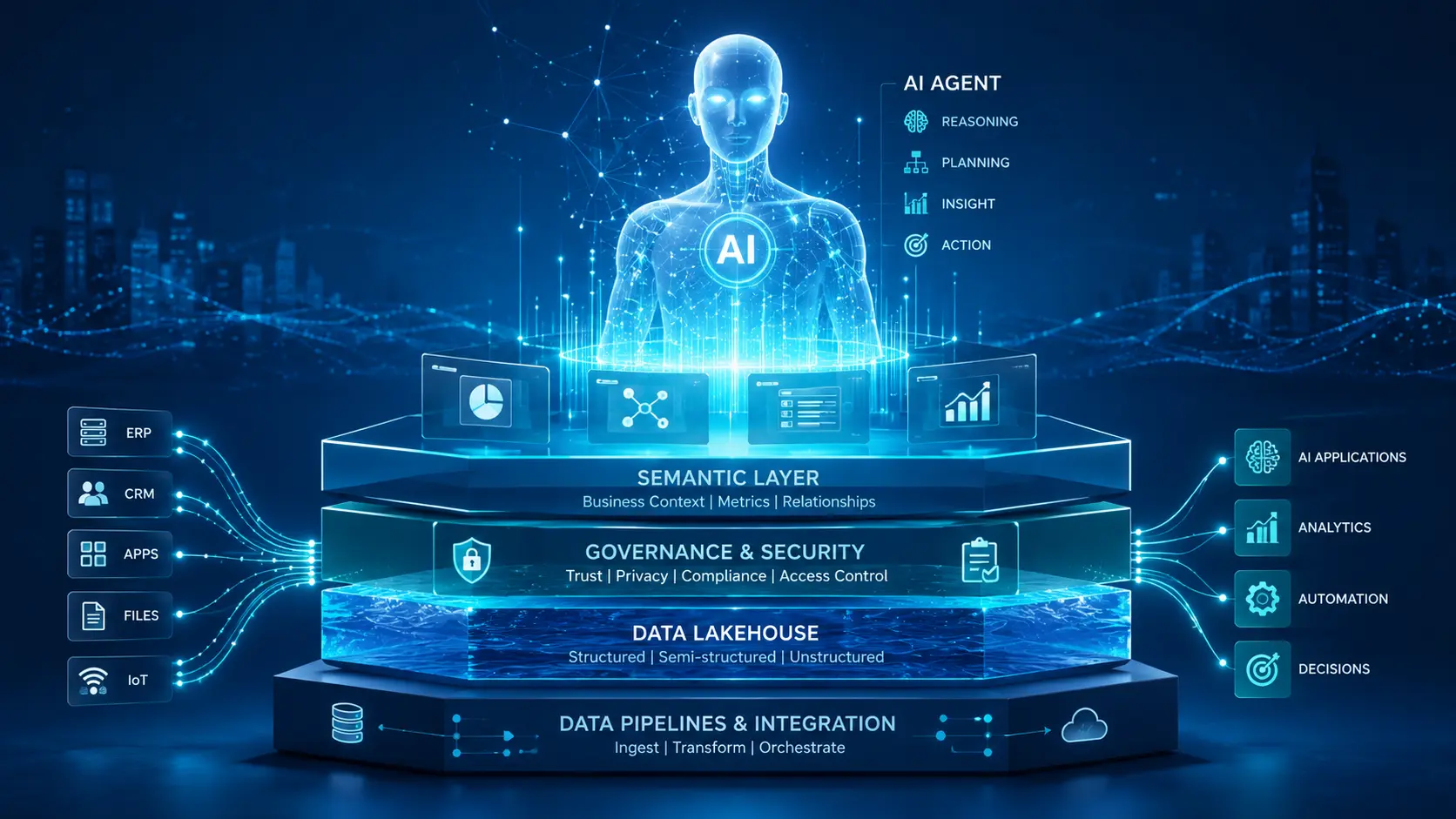
Over the last year, almost every major technology announcement has centred around AI.
Agentic AI. AI assistants. AI copilots. Autonomous agents.
The conversation has rapidly shifted from dashboards and reports towards systems capable of reasoning, planning and taking action.
Yet despite all the excitement, one question continues to stand out.
What happens when those AI agents don't have trustworthy data to work with?
AI is only as good as its foundations
One of the biggest misconceptions surrounding enterprise AI is that organisations can simply layer an LLM over their existing data estate and immediately begin generating value.
In reality, the opposite is usually true.
If data is fragmented across multiple platforms, poorly governed, inconsistently modelled or lacking business context, AI simply amplifies those problems rather than solving them.
Large language models may produce convincing answers, but without trusted data they cannot reliably produce correct answers.
The quality of the outcome is still determined by the quality of the underlying information.
The platform is becoming more important than the model
One of the themes I've explored extensively on Elffar Analytics is that the industry is undergoing a fundamental shift.
Modern data platforms are no longer just repositories for reporting and analytics.
They are evolving into integrated environments where data engineering, governance, semantic modelling, machine learning, vector search and AI operate together.
This is exactly why we've seen such rapid innovation around Oracle AI Data Platform, Autonomous AI Lakehouse and Oracle Analytics.
These capabilities are not isolated features.
They are the building blocks required to support enterprise AI safely and at scale.
Governance is an AI feature
As organisations move towards autonomous and agentic systems, governance becomes even more critical.
AI agents need to understand:
- which data can be trusted
- who is allowed to access it
- what business meaning it represents
- where it originated
- whether it is current
- whether it complies with regulatory requirements
Without these foundations, organisations risk replacing unreliable reporting with unreliable AI.
Good governance is no longer just about compliance.
It has become a prerequisite for successful AI.
Why this matters to me
Being invited to contribute a guest article to the Oracle Analytics blog was an honour. Seeing it published on Oracle's official platform is a milestone that I'm incredibly proud of.
What makes it especially meaningful, however, is that it validates a direction I've been exploring on Elffar Analytics for some time.
Over the past year, many of my articles have examined Oracle AI Data Platform, Autonomous AI Lakehouse, vector search, semantic modelling, governance and, more recently, agentic analytics. At first glance these appeared to be individual product announcements and technical innovations.
Looking back, they now form a much more coherent picture.
The industry is moving beyond treating analytics, data engineering and AI as separate disciplines. Instead, modern enterprise platforms are bringing them together into a single, governed ecosystem where trusted data becomes the foundation for intelligent systems.
That is exactly the message I wanted to convey in my Oracle guest article. Rather than focusing on AI in isolation, it explores why success with agentic AI depends on getting the fundamentals right first.
In many ways, the Oracle article isn't the start of a new conversation. It's the culmination of one I've been having throughout the past year.
Final thoughts
There is understandable excitement surrounding AI agents and autonomous decision making.
But organisations that invest first in data quality, governance, semantic understanding and modern data platforms will be the ones best positioned to realise that potential.
AI may be the destination.
Strong data foundations are what make the journey possible.
If you'd like to read my Oracle guest article, you can find it here:
From Lakehouse to Agentic AI: How Modern Analytics Platforms Are Reshaping Enterprise Data