AI
Why Oracle’s Architecture Matters for Agentic Analytics
In Part 1 of this blog series, I looked at why AI agents change the analytics conversation. The important shift is not simply that AI can answer questions, but that agents can keep working towards a goal, call tools,…
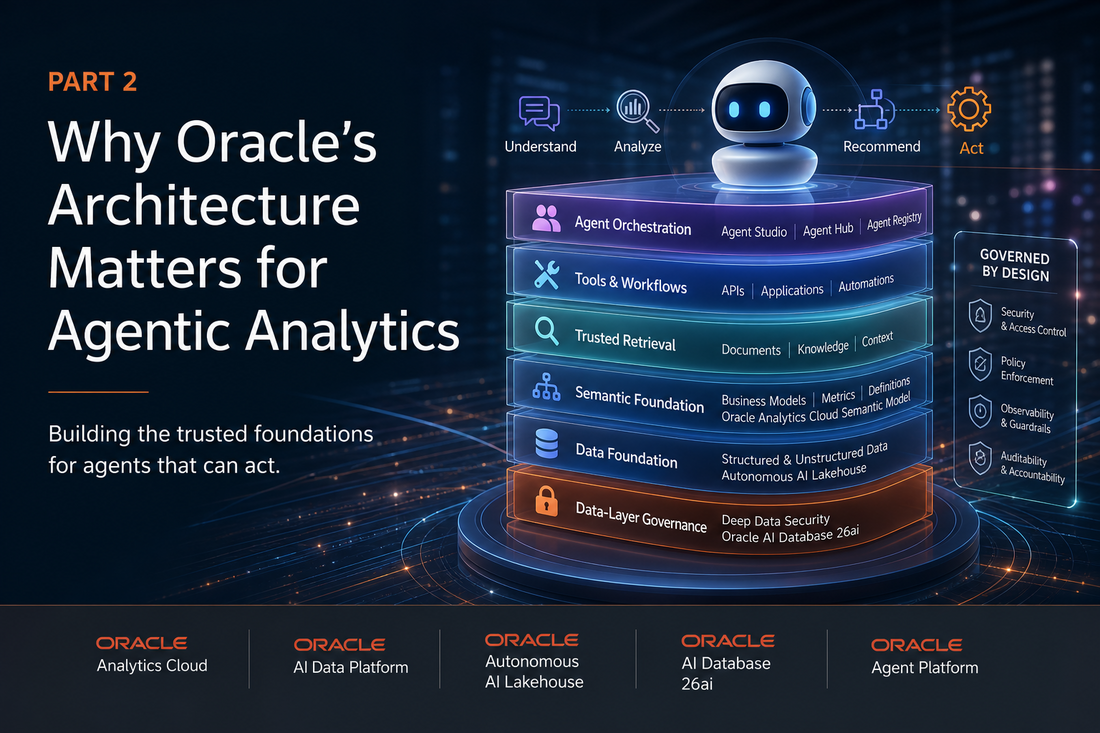
In Part 1 of this blog series, I looked at why AI agents change the analytics conversation. The important shift is not simply that AI can answer questions, but that agents can keep working towards a goal, call tools, retrieve context and potentially act on analytical findings.
That changes the risk profile. A wrong dashboard might mislead someone. A wrong agentic action can create consequences.
This second part looks at the architecture question: what needs to be in place before agentic analytics can be trusted in the enterprise?
Why Semantic Grounding Matters
This is where semantic models and business definitions become central. If an analytics agent is asked why revenue has fallen, what definition of revenue should it use? Gross revenue, net revenue, recognised revenue or booked revenue? Which hierarchy should it apply? Which region mapping should it follow? Which filters are appropriate for the user asking the question?
Without governed business meaning, an agent can produce an answer that sounds plausible but is analytically wrong.
That is why semantic models matter even more as analytics becomes agentic. They give agents a governed structure to reason over. They help ensure that the agent is not simply interpreting table and column names, but working with business concepts that have been defined, tested and approved.
In Oracle terms, this is where Oracle Analytics Cloud’s semantic model remains highly relevant. It provides a way to define measures, hierarchies, calculations, joins, aliases, descriptions and access rules that can ground AI-driven analytical experiences in trusted business meaning.
Why Governance Must Reach the Data Layer
Agentic analytics also raises another important question: where should governance be enforced?
It is not enough for governance to exist only in the front-end experience. If AI agents, analytics platforms, notebooks, APIs and downstream services can all access data through different routes, governance needs to be durable across those access paths. This is why data-layer governance matters.
Oracle’s direction with Deep Data Security in Oracle AI Database 26ai is relevant here. The idea of declarative, identity-aware access control closer to the database points towards a model where policies can be centralised at the data layer rather than being recreated separately in every consuming service.
For agentic analytics, that matters because agents may become another class of downstream consumer. They may request data, retrieve context and invoke services in ways that need to remain governed, auditable and aligned with enterprise policy.
Why Oracle’s Architecture Matters
This is where Oracle’s broader platform direction becomes interesting.
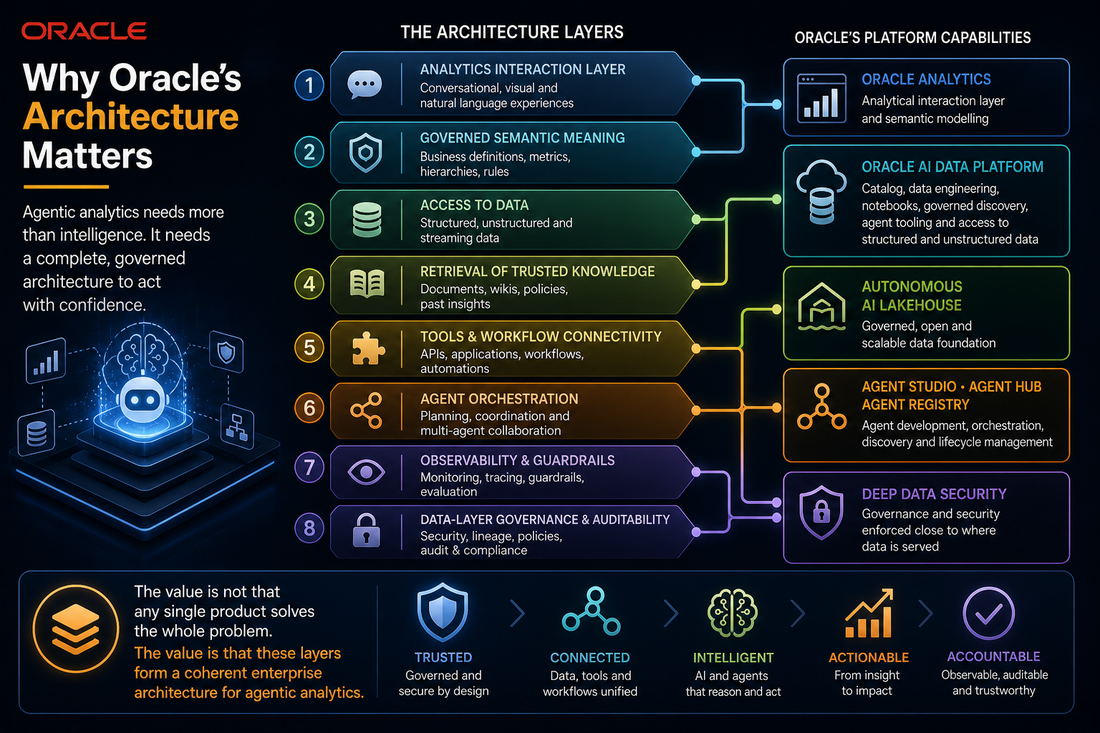
Agentic analytics needs several layers to work safely and effectively:
- an analytics interaction layer
- governed semantic meaning
- access to structured and unstructured enterprise data
- retrieval of trusted knowledge
- tools and workflow connectivity
- agent orchestration
- observability and guardrails
- data-layer governance and auditability
Oracle is increasingly assembling many of these layers across Oracle Analytics, Oracle AI Data Platform, Autonomous AI Lakehouse and agent platform capabilities.
Oracle Analytics provides the analytical interaction layer and semantic modelling foundation. Oracle AI Data Platform provides the broader environment for catalog, data engineering, notebooks, governed discovery, agent tooling and access to structured and unstructured data. Autonomous AI Lakehouse helps provide part of the governed data foundation. Agent Studio, Agent Hub and Agent Registry point towards a more explicit agent platform layer. Deep Data Security points towards governance being enforced closer to where the data is served.
The value is not that any single product solves the whole problem. The value is that these layers begin to form a more coherent enterprise architecture for agentic analytics.
From Insight to Action Requires Accountability
As analytics moves closer to action, accountability becomes central.
If an agent recommends a price change, triggers a supplier review, escalates a customer issue, updates a forecast or starts a workflow, the organisation needs to understand what data was used, which business definitions were applied, what context was retrieved, which tools were invoked, what permissions were evaluated, who approved or delegated the action, and what audit trail was created.
This is the difference between a clever demo and an enterprise-ready capability.
Agentic analytics should not simply be measured by whether it can produce an answer. It should be measured by whether the answer, recommendation or action is trusted, explainable, governed and accountable.
Conclusion
The Hannah Fry video was a useful reminder that AI agents change the conversation because they can act.
That is exciting, but it is also why agentic analytics needs more than intelligence. It needs architecture.
If analytics agents are going to interpret intent, retrieve context, explain findings, recommend next steps and potentially execute actions, then they need to operate within clear boundaries. They need governed data, semantic grounding, policy enforcement, observability, auditability and accountability.
For me, this is where Oracle’s platform direction becomes important. Oracle Analytics, Oracle AI Data Platform, Autonomous AI Lakehouse, agent platform capabilities and database-level governance all contribute to the foundations needed for agentic analytics to become enterprise-ready.
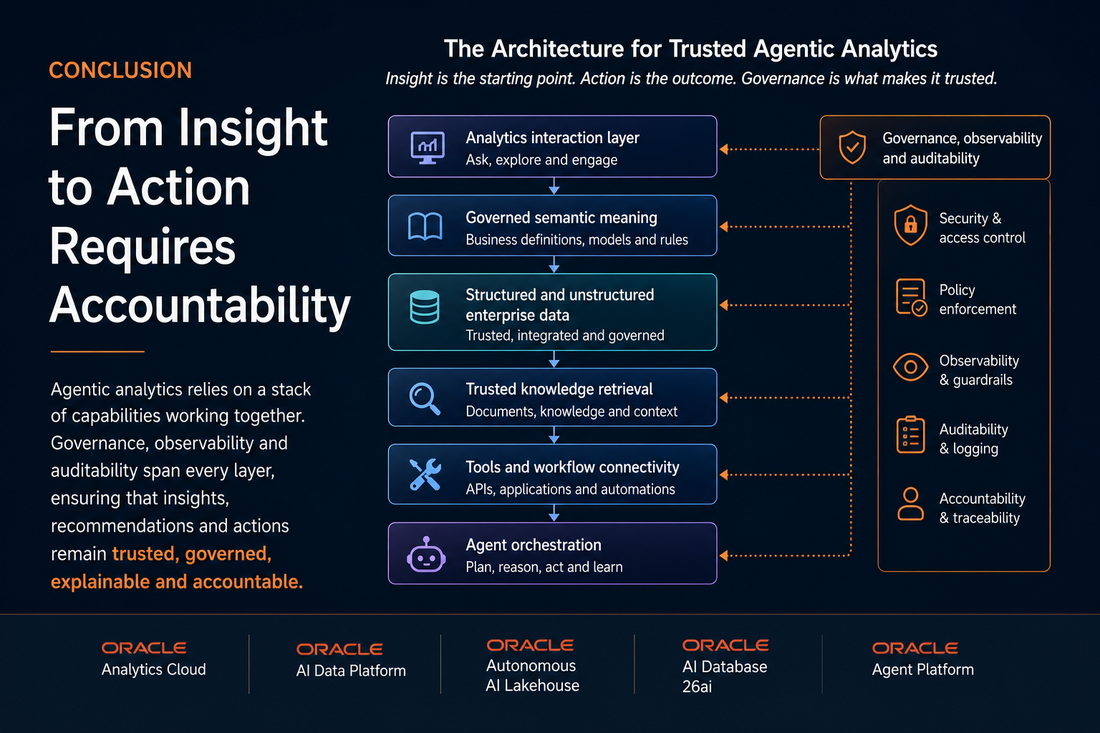
The question is not simply whether agents can act. The more important question is whether they can act within an architecture that makes those actions trusted, governed, explainable and accountable.