AI · OAC
Oracle Analytics Cloud AI Agent: Where Conversations Meet Context
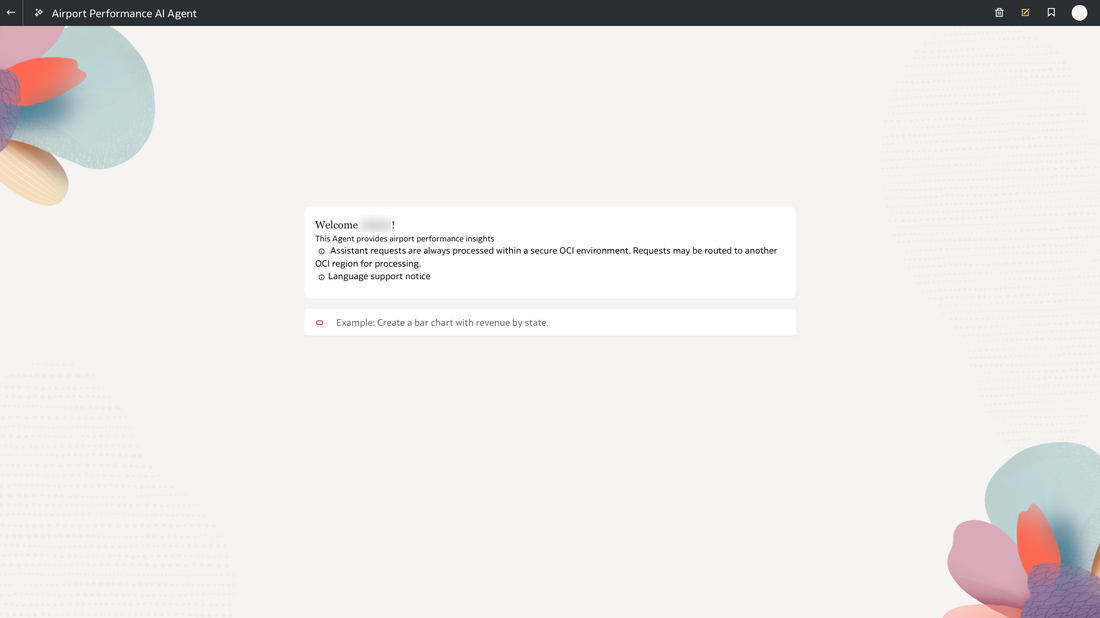
At a recent Oracle Analytics Partner Meeting, one demo stood out to me (the others were great as well!) - the new AI Agent for Oracle Analytics Cloud (OAC). I’ve since spoken further with the product manager and been…
At a recent Oracle Analytics Partner Meeting, one demo stood out to me (the others were great as well!) - the new AI Agent for Oracle Analytics Cloud (OAC). I’ve since spoken further with the product manager and been granted early access ahead of its LA (limited availability) in the November 2025 release, and I can already see the foundations of something significant taking shape.
At first glance, the OAC AI Agent looks and feels similar to the Fusion AI Agent Studio -and that’s no coincidence. Oracle appears to be unifying its redwood AI agent look and feel across platforms, enabling analytics, applications, and custom experiences to have a unified user experience. In OAC, this translates into an embedded conversational interface that sits directly within your analytics workspace. Ask a question, and the agent doesn’t just return a text summary - it understands your semantic model, data lineage, and context before generating a response.
From Chatty to Knowledgeable: The Librarian Analogy
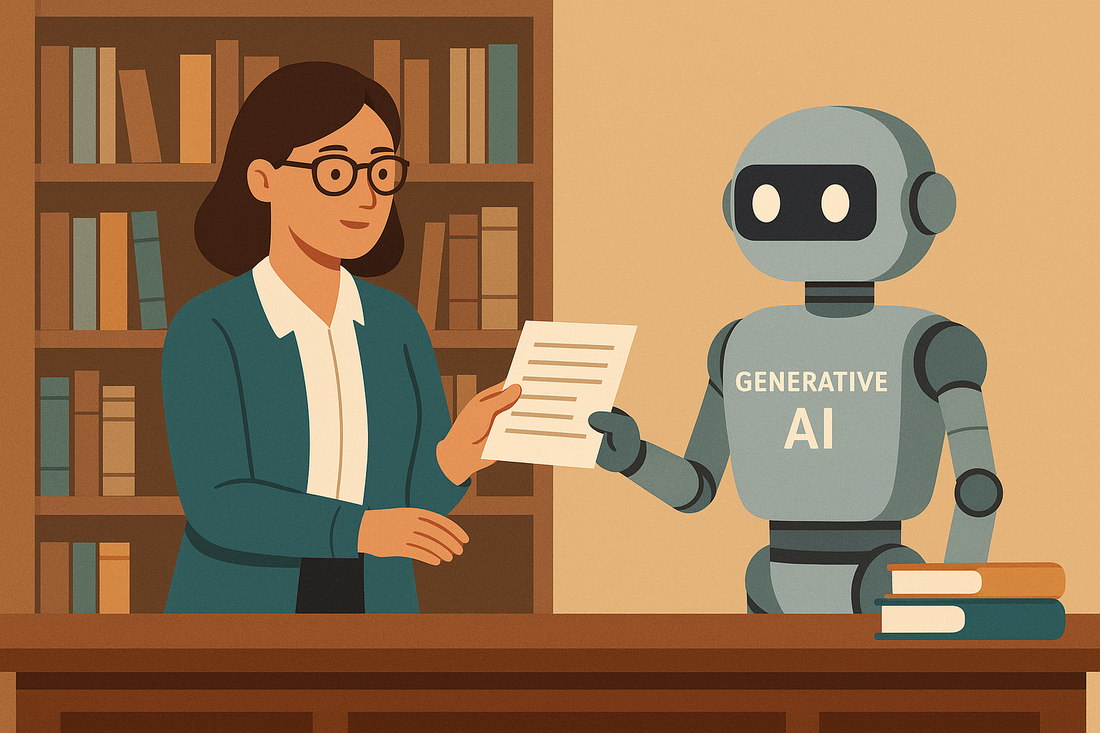
To understand what makes this so important, it helps to think of the AI Agent as a librarian.
A large language model (LLM) on its own is like a well-spoken librarian with an excellent memory but no access to your organisation’s archive. Ask them a question, and they’ll respond confidently and eloquently but they’re drawing only on general world knowledge and patterns they’ve learned before. The result often sounds convincing, yet it may lack the precision or evidence that a business decision demands.
The OAC AI Agent, on the other hand, gives that librarian the keys to your private archive. When you ask a question, they don’t just rely on memory and their extensive real-world knowledge; they walk into your own library of governed data, reports, and documents, retrieve the most relevant material, and then craft a response grounded in fact.
That’s the power of Retrieval-Augmented Generation (RAG) - it lets Oracle’s AI Agent combine the fluency of language models with the factual grounding of your enterprise knowledge.
How the OAC AI Agent Works
Creating an AI Agent in Oracle Analytics Cloud
To begin creating an AI Agent, navigate to the menu and select the Create AI Agent option.
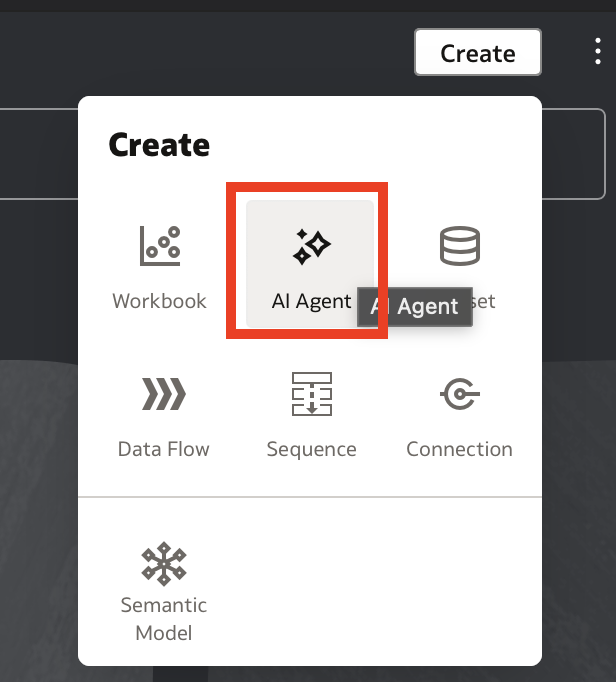
This initiates the process and brings you directly to the AI Agent configuration Immediately upon entering the configuration screen, you are prompted to add a dataset that will serve as the foundation for the AI Agent. It is essential to ensure that this dataset has already been indexed and appropriate synonyms for attributes have been configured.
These preparatory steps are crucial for enabling the AI Agent to effectively leverage the dataset and provide meaningful, context-aware responses.
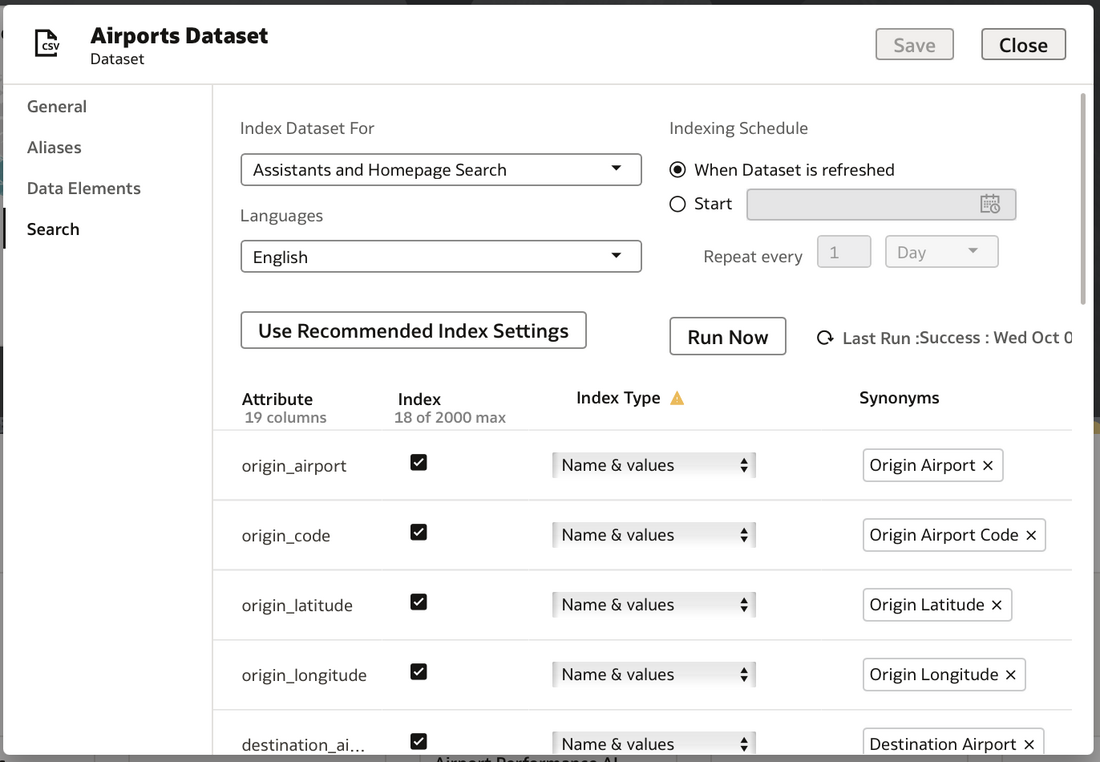
Dataset configuration
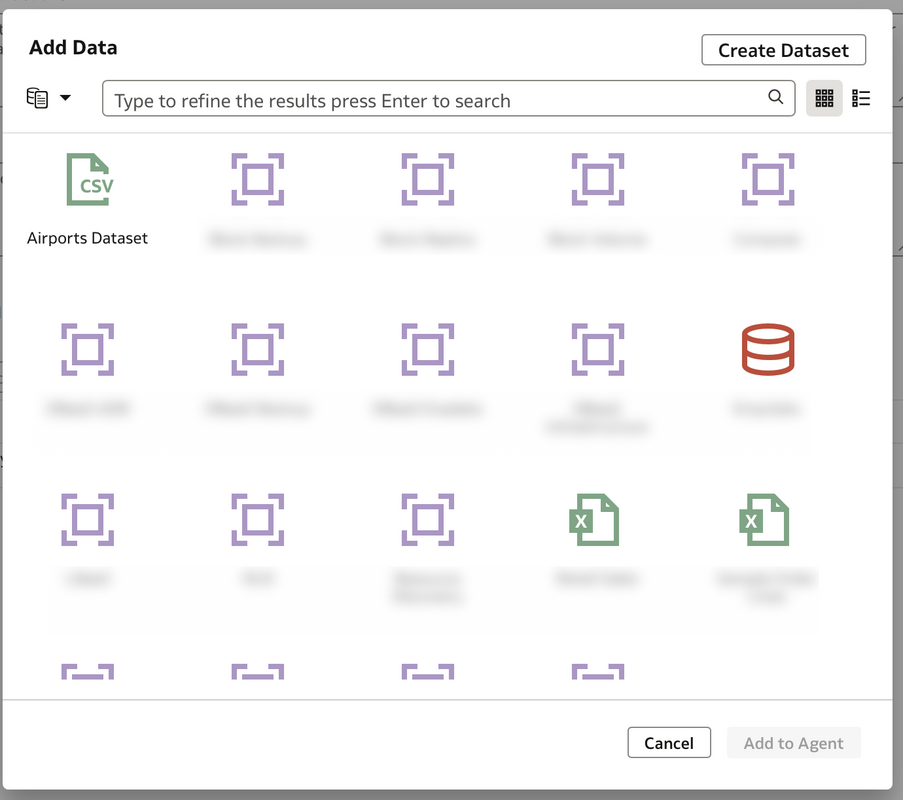
Select dataset to add to AI Agent
You are then taken to the configuration screen
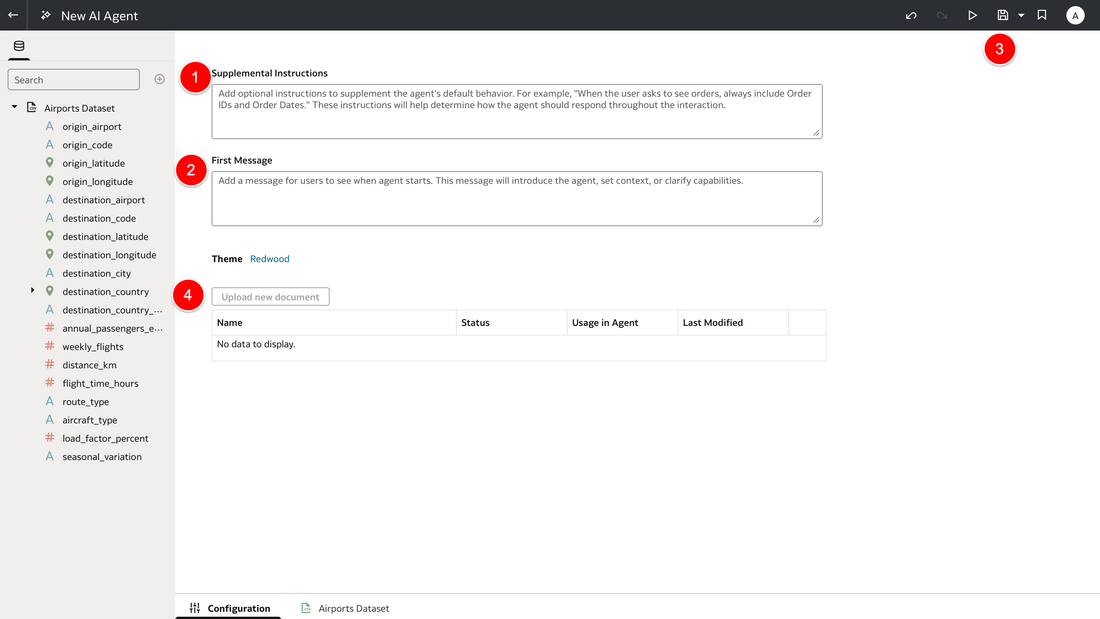
OAC AI Agent configuration
Configuring and Supplementing the OAC AI Agent
Step 1: Entering Supplemental Instructions
Begin by providing supplemental information that offers the agent additional context regarding its specific use case. Additional prompt Instructions will help the agent better interpret user questions on a functional domain. This ensures the AI Agent is tailored to the unique requirements and environment it will operate within.
Step 2: Defining the First Message
The First Message serves as an introductory text displayed to users interacting with the agent. It describes the agent’s purpose and sets expectations for what the agent is designed to achieve.
Step 3: Saving the Agent
After all relevant information has been entered, proceed to save the agent. This action records the configuration and prepares the agent for further enhancement.
Step 4: Supplementing with Documents
Once the agent has been saved, you can enhance its capabilities by supplementing the previously entered contextual information with additional documents. Uploading these documents grounds the agent in your organisation’s custom enterprise knowledge, allowing it to provide more accurate and relevant responses.
OAC AI Agent: Technical Foundations
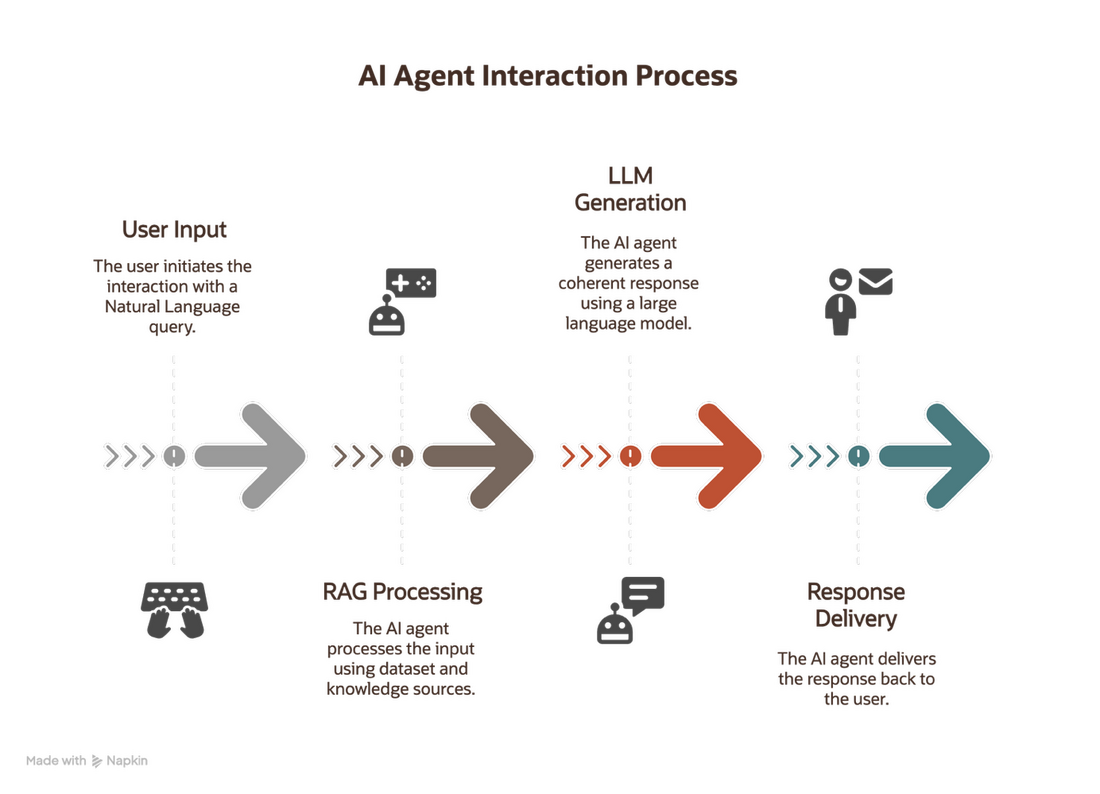
At its core, the OAC AI Agent leverages the vector search capabilities of the Oracle infrastructure which forms the backbone of OAC. This vector search enables the agent’s retrieval augmented generation (RAG) functionality, allowing it to efficiently surface relevant information in response to user queries. The OAC AI Agent achieves this by integrating three essential components, each playing a critical role in transforming natural-language questions into trustworthy, contextual insights.
1. Intent Recognition (LLM Layer)
The large language model (LLM) layer is responsible for interpreting what the user is seeking. It analyses the natural-language query to determine the user’s intent and aligns this intent with relevant datasets, key performance indicators (KPIs), or dashboards available within OAC.
2. Retrieval Layer (RAG Engine)
Once the user’s intent has been established, the agent’s retrieval layer searches for pertinent content across a range of defined governed sources. This process begins with OAC’s own semantic model and expands to include external knowledge repositories. Examples custom knowledge files that have been uploaded to the system or supplemental information defined in the AI agent.
3. Response Rendering (OAC Context)
After retrieving the necessary data and knowledge, the information passes through Oracle’s Analytics Visualisation framework. The agent then generates a natural-language response that is firmly rooted in verified data, ensuring that every response respects OAC’s metadata, data lineage, and security protocols.
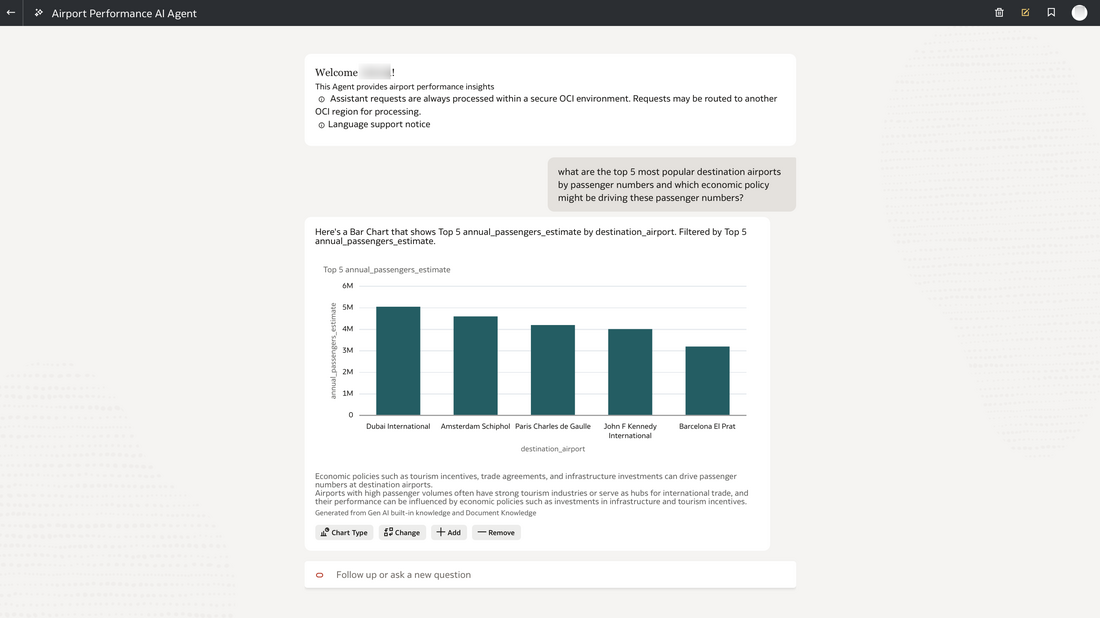
Results from an OAC AI Agent
Key Features and Considerations
Dataset Preparation and Management
- Indexing and Synonym Setup: Ensure that the dataset is properly indexed and that relevant synonyms have been configured. This facilitates more effective and accurate retrieval of information based on user queries.
- Column Exclusion: Exclude any columns that are not required for analysis or retrieval. This helps streamline data processing and maintains the relevance of the dataset.
- Supported Document Formats: Custom Knowledge documents can be uploaded in both .PDF and .TXT formats, allowing for flexibility in the types of information included.
- Single Dataset Limitation: At present, only one dataset can be used at a time, ensuring focus and coherence in data retrieval and analysis.
- Dataset Filtering: Filters can be applied to the dataset, enabling users to narrow down the scope of information based on specific requirements or criteria.
Context and Accessibility
- Contextual Insights: Context is derived from both supplemental information and any uploaded documents, ensuring responses are grounded in the most relevant and up-to-date knowledge.
- Accessibility: The feature is accessible either from the AI Agent menu option or directly via the AI Assistant in the Insights panel, providing users with flexible entry points for their queries.
How the OAC AI Agent Delivers Value
The OAC AI Agent produces responses that are designed to be highly effective for business users. This is achieved through a combination of generative AI capabilities, robust grounding in enterprise knowledge, and adherence to organisational standards.
- Conversational — The responses are naturally conversational, leveraging the power of generative AI to deliver fluid and engaging dialogue that feels intuitive and approachable.
- Grounded — Each response is firmly anchored in knowledge derived from enterprise data and documents, ensuring accuracy and relevance by referencing up-to-date information from within the organisation.
- Governed — All output remains consistent with your organisation’s security protocols and definitions, providing confidence that information is managed and shared in line with established governance frameworks.
This unique blend of conversational fluency and factual accuracy distinguishes the OAC AI Agent from standalone chat-based AI tools, delivering responses that are both engaging and trustworthy for enterprise use.
Early Days, Big Potential
Let’s be clear — this feature is in its infancy. The current build focuses on natural-language exploration incorporating Retrieval-Augmented Generation (RAG) and narrative generation, with a roadmap that will expand its reasoning and automation capabilities over time.
What’s exciting isn’t just the interface, but the architecture that’s emerging beneath it. For the first time, Oracle Analytics is embracing Retrieval-Augmented Generation (RAG). That means the AI Agent won’t rely solely on a large language model to generate responses. Instead, it will retrieve and ground its output in enterprise data and knowledge — both structured and unstructured.
In practical terms, this opens the door for analysts and business users to ask questions that blend internal data with documents, policies, reports, and contextual information stored across the organisation. Whether it’s sales performance data, a product specification PDF, or a customer-service transcript, the AI Agent will eventually be able to bring these sources together to deliver context-aware insights.
Bringing Unstructured Knowledge into the Analytics Conversation
Historically, analytics platforms have struggled to bridge the gap between structured data (tables, metrics, and KPIs) and unstructured information (documents, notes, images, or messages). With RAG, Oracle is moving to close that gap.
This isn’t just about generating summaries — it’s about creating a richer, more informed analytical experience. Imagine asking:
“What were the main factors behind last quarter’s decline in customer satisfaction?”
Today, OAC might point you to a metric or dashboard. With RAG, the AI Agent could augment that response with context drawn from call-centre transcripts, customer feedback reports, or support documentation — all retrieved securely from enterprise knowledge stores.
The result is a shift from data-driven insights to knowledge-driven understanding.
Governed Intelligence, Oracle Style
One of the key advantages here is governance. Unlike standalone chatbots, the OAC AI Agent inherits the same security, metadata, and lineage controls that underpin Oracle Analytics. Responses remain explainable, consistent, and aligned with the organisation’s governed data model — ensuring that insights stay reliable even as AI becomes more conversational.
This approach also complements Oracle’s broader AI ecosystem. The same underlying framework powers Fusion Applications and APEX AI Agents. As these services evolve, we can expect deeper integration, shared prompt orchestration, and unified management of knowledge sources across the Oracle Cloud stack.
Looking Ahead
The OAC AI Agent represents a starting point, not a destination. It’s a glimpse into where analytics is heading — from dashboards and KPIs towards context-aware conversations grounded in enterprise knowledge.
As I explore this feature further through early access, I’ll be focusing on:
- How RAG is implemented and where knowledge sources can be defined.
- The interplay between OAC’s semantic model and retrieval layers.
- How well the agent can integrate unstructured enterprise knowledge into analytical reasoning.
For now, it’s early days — but the direction is clear. With the AI Agent, Oracle Analytics isn’t just adding generative AI to dashboards; it’s laying the foundation for a new class of governed, knowledge-aware analytics experiences.
Stay tuned — I’ll share a deeper hands-on review once the November 2025 update goes live.