AI · AIDP
Introducing Oracle AI Data Platform: A Unified Foundation for Enterprise AI
Artificial intelligence is no longer a side project. For enterprises, AI has become a strategic priority—transforming how organisations innovate, compete, and operate. Yet most businesses still struggle with fragmented…

Artificial intelligence is no longer a side project. For enterprises, AI has become a strategic priority—transforming how organisations innovate, compete, and operate. Yet most businesses still struggle with fragmented data pipelines, disconnected tools, and governance challenges that slow down progress with the underlying root cause being how disparate data exists in enterprises.
While 78% of organisations planned to use AI in 2024 (Global AI Adoption Statistics: A Review from 2017 to 2025), the reality is that 68% of these organisations have data silos as their top concern (Data Strategy Trends in 2025: From Silos to Unified Enterprise Value - DATAVERSITY), and siloed data can cost companies up to 30% of their annual revenue (What are Data Silos and What Problems Do They Cause?|Definition from TechTarget). The culprit? The average enterprise runs on nearly 900 applications, with only one-third integrated (What Are Data Silos & Why is it a Problem? | Salesforce US), creating the very fragmentation that prevents AI success.
Think of enterprise data like a busy international airport. Passengers arrive from different places, each with different documentation requirements:
- Structured data is like UK passengers, travelling with standard passports and predictable checks and these passengers can make use of automated technology to speed through the airport.
- Semi-structured data is like EU passengers, still fairly standardised but with slight differences in documentation and rules.
- Unstructured data is like international passengers from all over the world, carrying varied paperwork that requires more manual checks and scrutiny.
Without a well-designed terminal, air traffic control, and secure customs processes, it would be chaos.
The new Oracle AI Data Platform (AIDP) is that airport terminal for AI—a single hub where all types of data arrive, is organised, governed, and routed to their various destinations so Analytics tools and AI applications can “take flight” safely and efficiently.
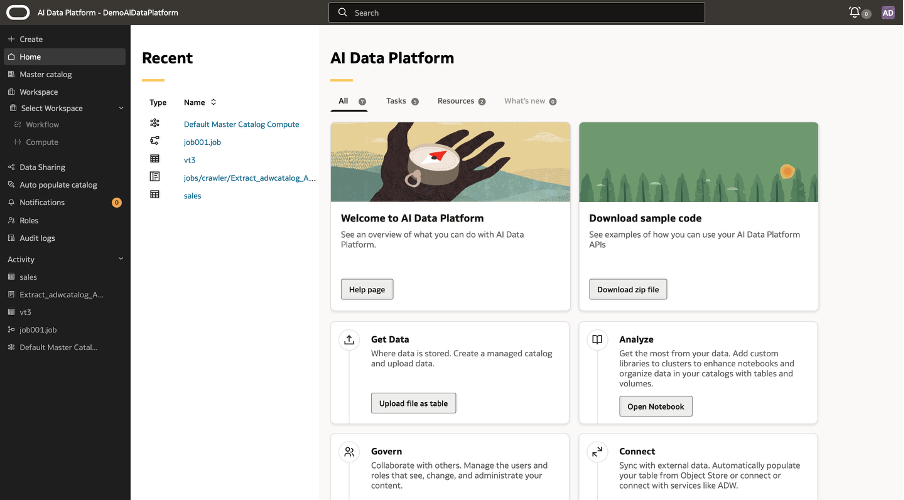
Oracle announced the AI Data Platform at Oracle AI World in Las Vegas on 14 October 2025, and it’s now generally available. Customers can access the live product site and documentation today, meaning you can onboard, configure the Master Catalog, and start building governed lakehouse-plus-AI pipelines on OCI straight away.
Why Oracle AI Data Platform Matters
At its core, AIDP helps enterprises do three things better:
- Unify enterprise data for AI: Bring together all your data into a connected platform, removing silos and creating AI-ready pipelines.
- Accelerate AI development: Use integrated tools, notebooks, and GenAI agent frameworks to move faster without the overhead of stitching together separate environments.
- Innovate at scale: Orchestrate AI workloads across Oracle and third-party environments, backed by OCI’s optimised infrastructure for cost-effective performance.
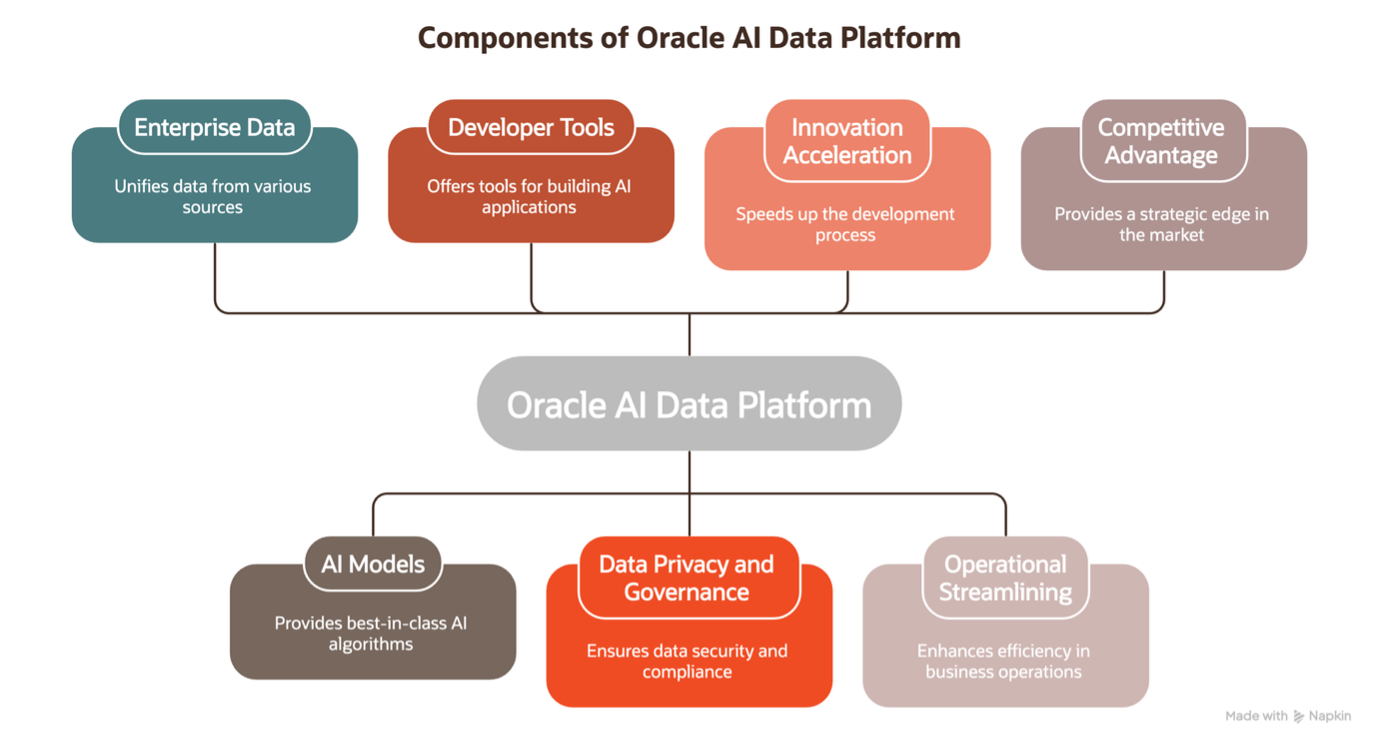
The result? Faster time to value, improved governance, and the ability to scale AI beyond pilots into real enterprise impact.
A Hypothetical Use Case: From Data Warehouse to AI-Powered Insights
Consider a typical scenario:
- An enterprise has built a robust data warehouse in Autonomous Database (ADW) to consolidate structured data.
- Oracle Analytics Cloud (OAC) provides dashboards and visualisations, helping business teams track KPIs and trends.
- However, AI isn’t being used, and unstructured data—documents, images, logs, call transcripts—sit outside the analytical process.
Here’s how AIDP helps transform this setup:
- Bring unstructured data into play: AIDP can ingest and catalogue documents, PDFs, and multimedia alongside structured ADW data, enriching the analytical picture.
- Enable AI-driven insights: Data scientists and analysts can use AIDP’s Spark notebooks to apply machine learning models directly on both structured and unstructured datasets.
- Governance and trust: With Row-Based Access Control (RBAC), metadata cataloguing, and lineage, all new AI-ready datasets are managed as securely and reliably as the ADW warehouse.
- Seamless analytics in OAC: OAC continues as the visualisation layer, now enriched with AI-derived features and predictive insights.
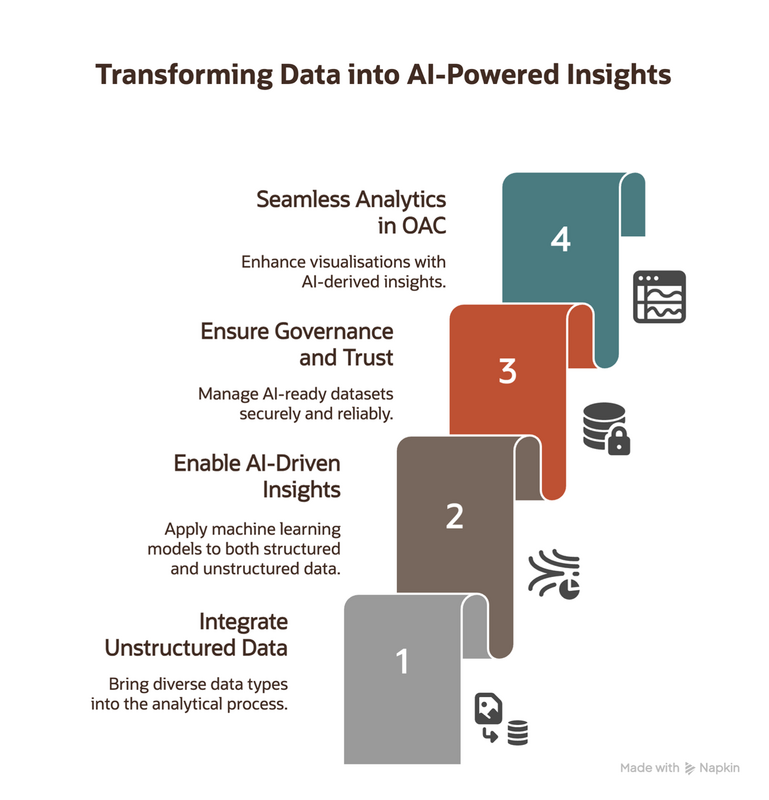
In short, AIDP helps organisations move beyond descriptive dashboards to predictive and prescriptive intelligence, while leveraging the investments already made in ADW and OAC.
How Oracle AI Data Platform Supports the Full Data Workflow
One of AIDP’s key strengths is that it covers the entire lifecycle of enterprise data, much like how an airport manages passengers from arrival to departure.
- Ingestion from multiple sources (Arrivals Hall)
- Data enters from many places: SaaS apps, IoT devices, on-prem systems, and third-party feeds.
- Like flights arriving from different countries, each data source brings its own rules and timing:
- Structured data (UK passengers) with standard passports and predictable checks.
- Semi-structured data (EU passengers) with slightly different but still fairly standardised documents.
- Unstructured data (Other international passengers) carrying diverse documents that require more careful checks.
- Data storage (Baggage Claim & Holding Areas)
- Object Storage manages unstructured data (the oversized luggage, odd-shaped items that don’t fit neatly).
- Autonomous Database (ADW) holds structured data (the regular suitcases, perfectly tagged and easy to track).
- Open table formats like Delta Lake, Iceberg, and Hudi ensure every type of “baggage” is stored consistently, like a baggage system designed to handle every airline’s rules.
- Transformation and enrichment (Customs & Security)
- Just as passengers go through passport control and security checks, data must be cleaned, validated, and enriched.
- Spark-powered compute and workflow orchestration make this process smooth, while ensuring compliance and efficiency.
- Governance and security (Immigration & Border Control)
- The Master Catalog is the record of who entered, when, and what they carried.
- RBAC and lineage enforce strict policies—only the right people can access the right data, just as border officers verify visas and permissions.
- AI and advanced analytics (Departure Gates)
- Once cleared, passengers board their flights to final destinations.
- In AIDP, this is where data powers machine learning, GenAI agents, and predictive analytics—transforming raw arrivals into actionable journeys.
- Consumption and collaboration (Connections & Departures)
- Finally, passengers (data) connect to their flights—whether that’s Oracle Analytics Cloud dashboards, third-party BI tools, or Delta Sharing with partners.
- Smooth transfers ensure data doesn’t get delayed, lost, or misdirected.
By covering every stage of the workflow, AIDP ensures that UK (structured), EU (semi-structured), and international (unstructured) passengers all move smoothly through the airport, reaching their destinations as trusted, AI-driven insights.
What is the Medallion Architecture?
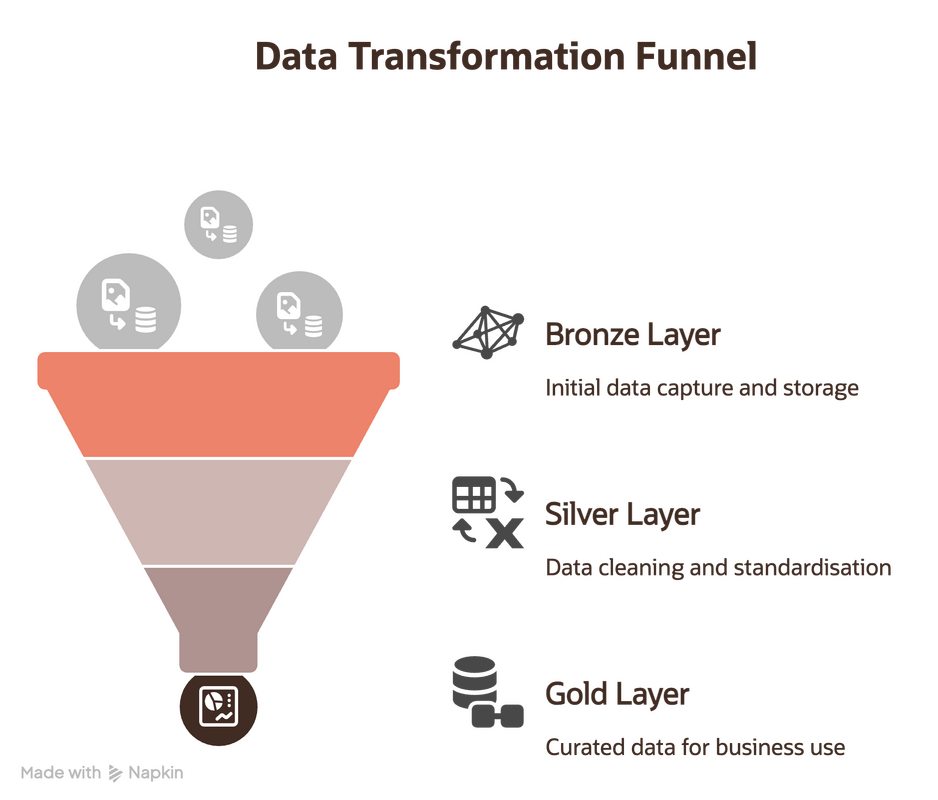
The Medallion Architecture is a layered data design pattern used to organise data in a data lake or lakehouse for clarity, quality, and reusability. It’s structured into three main layers: Bronze, where raw data is ingested “as is” from source systems; Silver, where data is cleaned, validated, and enriched for consistency and reliability; and Gold, where curated, business-ready data is optimised for analytics, reporting, and machine learning. This layered approach improves data quality at each stage while maintaining traceability from raw to refined insights.
In AIDP, this spans Object Storage, open table formats (Delta/Iceberg/Hudi), and Autonomous Data Warehouse (ADW), all governed by the Master Catalog and RBAC.
Bronze — Land (raw, “as is”)
Purpose: Capture the truth of what arrived, without fixing it yet.
- Structured (databases/SaaS): Land extracts or CDC snapshots into Object Storage and/or register ADW tables via an External Catalogue for zero-copy access. Keep source fidelity (datatypes, nulls, odd codes).
- Semi-structured (JSON/events): Land JSON, Avro, CSV, Parquet as-is in Object Storage; record schema hints only.
- Unstructured (files/media): Land documents, images, audio, logs in Object Storage as Volumes.
- Operations/Governance: Minimal transforms. Stamp ingest metadata (source, load time, checksum); start lineage; coarse RBAC.
Airport analogy: arrivals hall — busy, mixed, unfiltered.
Silver — Refine (cleaned, standardised, enriched)
Purpose: Make data structurally sound, consistent and joinable.
Structured track:
- Standardise datatypes, units, currencies and codes; de-duplicate; enforce keys and constraints.
- Build conformed dimensions, SCD staging, and validated facts.
- Write out as Delta/Iceberg/Hudi or materialise into ADW staging if warehousing downstream.
Semi-structured track:
- Parse/flatten JSON, infer/lock schemas, normalise arrays/maps to relational sets.
Unstructured track:
- Use Spark + OCR/NLP/speech to extract entities/tables/text.
- Normalise into rows/columns; de-dup; add confidence scores.
Convergence:
- Join structured with extracted signals (e.g., customer_id, invoice_no, email/phone hash for entity resolution).
- Apply quality tests (row counts, referential integrity, domain checks).
- Everything catalogued with lineage back to Bronze (files/tables).
Airport analogy: organised lounge — fewer people, rules applied, order emerging.
Gold — Serve (curated, business-ready)
Purpose: Publish trusted datasets for BI, ML and sharing.
- Warehouse-centric pattern: Load Gold into ADW for fast SQL, governance, and your existing semantic layer; OAC/Power BI/Tableau connect via SQL/JDBC. Ideal when most reporting already lives in ADW.
- Lakehouse-centric pattern: Keep Gold as Delta/Iceberg/Hudi on Object Storage; expose via JDBC/Delta Sharing; OAC blends lakehouse Gold with ADW facts if needed. Ideal when you want minimal data movement and time-travel/ACID on the lake.
- Outputs: Conformed facts/dims, KPI marts, and feature tables for ML/GenAI.
Airport analogy: premium lounge — calm, curated, ready to board.
AIDP makes implementing this pattern simpler, with built-in orchestration and governance.
What Are Delta Lake, Iceberg, and Hudi?
If you’re new to these technologies, here’s a quick explainer:
- Delta Lake: Adds reliability to data lakes with ACID transactions, schema evolution, and time travel.
- Apache Iceberg: Optimised for very large analytic tables, with scalable metadata management.
- Apache Hudi: Focuses on streaming ingestion and incremental processing.
AIDP supports all three through Delta Uniform, giving enterprises flexibility without lock-in.
Built on Open Source, Delivered as Managed
Enterprises want the flexibility of open source, without the overhead of managing it at scale. AIDP blends the best of both:
- Apache Spark for scalable compute
- Delta Lake, Iceberg & Hudi support via Delta Uniform
- JDBC for BI connectivity to OAC, Tableau, Power BI
The Bigger Picture
With AIDP, Oracle isn’t just building another data platform — it’s constructing the air traffic control tower of enterprise AI. Think of your data as flights arriving from every corner of the globe: structured data landing from domestic routes, semi-structured touching down from across Europe, and unstructured streaming in from long-haul international journeys. AIDP coordinates the safe arrival, organisation, and departure of all of them, ensuring each passenger is where they need to be. By reducing unnecessary transfers, keeping to open flight paths, and providing a single terminal for AI development, Oracle makes sure your entire data estate operates like a well-run airport — efficient, secure, and ready to deliver value.
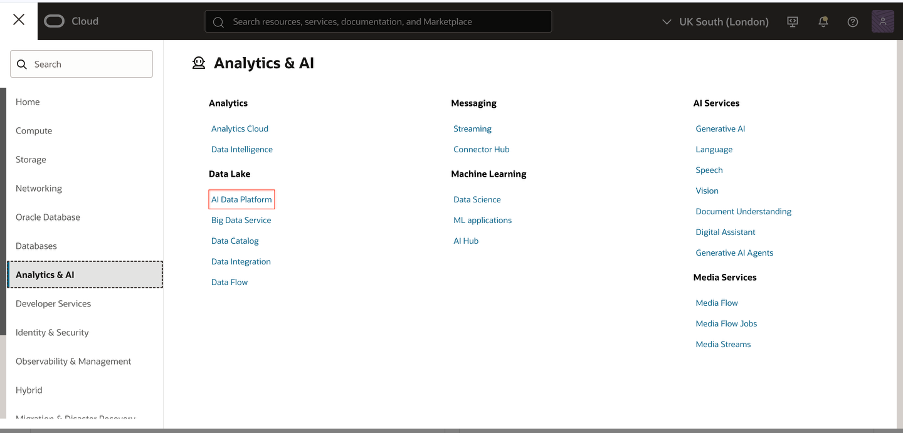
Ready to transform your data chaos into AI-powered insights? Explore Oracle AI Data Platform and see how it can serve as your enterprise's AI airport terminal.