FDI
Fusion Data Intelligence Under the Hood: A Deep Dive into the Architecture
In the previous post, we traced how Fusion Data Intelligence (FDI) evolved from OBIA. In this second instalment of our FDI‑introductory series, you’ll explore the underlying technology and architecture that power FDI’s…

In the previous post, we traced how Fusion Data Intelligence (FDI) evolved from OBIA. In this second instalment of our FDI‑introductory series, you’ll explore the underlying technology and architecture that power FDI’s cloud-native analytics platform.
2. The FDI Architecture Ecosystem (The “Big Picture”)
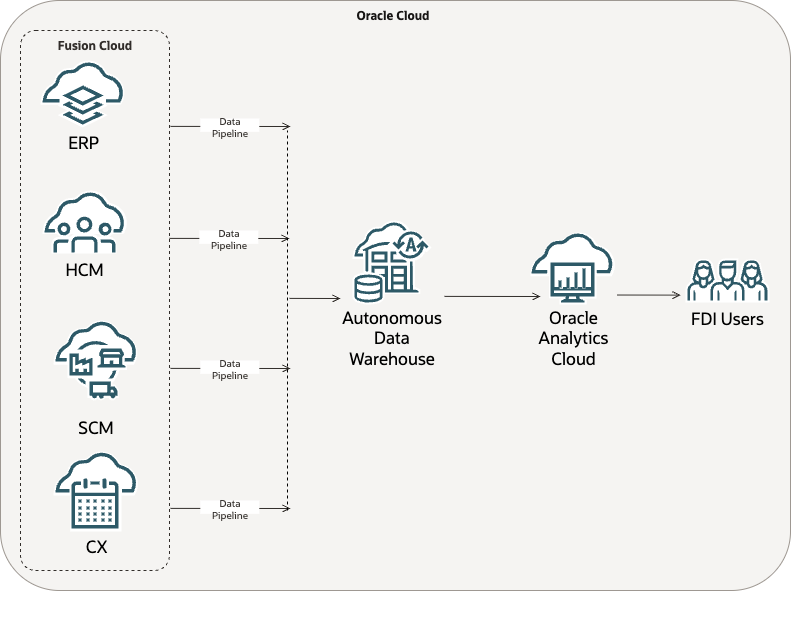
At its core, Fusion Data Intelligence (FDI) is a fully managed, cloud-native analytics platform running on Oracle Cloud Infrastructure (OCI). It stitches together your Fusion Cloud Applications, Oracle-managed data pipelines, Autonomous Data Warehouse (ADW), and Oracle Analytics Cloud (OAC) into a seamless, scalable end-to-end analytics solution - one that Oracle deploys, operates, and continuously evolves for you (there is some configuration that administrators need to carry out).
First, Fusion Cloud SaaS applications - including ERP, HCM, SCM and CX pillars - serve as the transactional data sources. Oracle provides prebuilt ingestion pipelines tailored to each functional Pillar, handling everything from data extraction and change data capture (CDC) to transformation and consistent mapping into analytics-ready format .
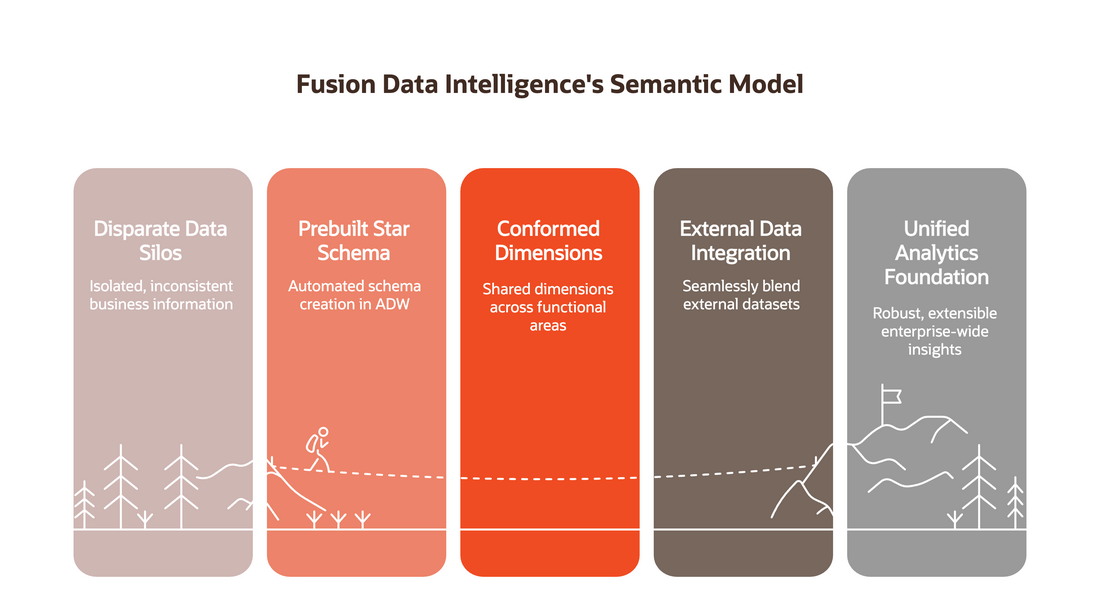
These pipelines write data directly into an OCI-hosted Autonomous Data Warehouse, which transform and load the Fusion data into a unified star-schema data model covering multiple functional domains. The schema is:
- Immutable and prebuilt, reducing modelling effort,
- Extensible, allowing for additional external or custom Fusion data,
- Optimised for high-performance querying across SaaS application pillars via Conformed Dimensions like customer, product, ledger and fiscal calendar .
This architecture supports refreshes that can be scheduled incrementally or on demand, with zero downtime - ensuring analytics remains uninterrupted during data pipeline updates. Custom flexfield extensions from Fusion Applications can be included in the pipelines, bringing bespoke business data into the analytics layer.
Once data arrives in the Autonomous Data Warehouse (ADW), Oracle Analytics Cloud takes over for semantic modelling and visualisation. A prebuilt semantic layer wraps the raw star schema into business-friendly subject-area views - covering finance, human resources, supply chain and customer experience - complete with standardised key metrics and dashboards .
Through OAC, FDI delivers not just dashboards but intelligent, action-driven analytics, featuring natural-language querying, ML-based forecasting and anomaly detection to name just a few.
🔗 Summary Flow
- Fusion SaaS Apps (ERP/HCM/SCM/CX) →
- Oracle-managed data ingestion pipelines (CDC, ETL, flexfield support) →
- Star-schema data model in Autonomous Data Warehouse (extensible star schema, conformed dimensions) →
- Oracle Analytics Cloud (semantic layer, dashboards, AI powered insights and intelligent apps).
This end-to-end ecosystem is fully managed by Oracle - covering provisioning, upgrades, performance tuning, and integration with Fusion App releases - offering a friction-free, scalable approach to enterprise analytics (there is some configuration that needs to be done by administrators).
3. Data Movement & Integration
FDI’s data movement layer is built around Oracle-managed, prebuilt pipelines that automate ELT and Change Data Capture (CDC) for Fusion Applications (ERP, HCM, SCM, CX). These pipelines are configured and controlled through the intuitive FDI Console, making it easy for administrators to activate, modify or schedule updates with minimal effort. You don’t need to build complex ETL processes - Oracle handles the heavy lifting, while you focus on business relevance and reporting needs .
By default, data pipelines are incremental with zero downtime, keeping analytics up-to-date without interrupting service. You also have the flexibility to perform on-demand full reloads, useful for data corrections or model updates - all managed with just a few clicks in the Console .
Crucially, the architecture supports extensibility in two key ways:
- Fusion data flexibility – Custom flexfields defined in Fusion Apps are automatically picked up and mapped into the ADW schema without additional development .
- External data ingestion – You can supplement your analytics with data from outside Oracle, using FDI Console’s data augmentation connectors (e.g. Salesforce, EBS, PeopleSoft, Shopify), self-service file uploads (Excel), direct ETL tools like Oracle Data Integrator, Oracle Integration Cloud or your choice of third-party loaders to a custom schema in the same ADW instance. For bulk external loads, FDI supports bulk data augmentation jobs that can be scheduled and monitored via the Console UI .
All pipelines and augmentations are managed through the FDI Console. As an administrator, you can configure initial parameters - such as extract start dates, currency preferences, and schedule frequency - directly in the console interface. Any subsequent edits to pipelines, functional areas, or augmentations are seamless, with Oracle handling deployment and execution behind the scenes
✅ Summary: Core Benefits of FDI Pipelines
| Feature | Benefit |
| Oracle Managed Pipelines | Low maintenance, no custom ETL |
| Console based configuration | Easy scheduling without code |
| Zero downtime incremental loads | Fresh data, uninterrupted analytics |
| Flexfield support | Easy to add custom business fields |
| External data extensibility |
Blend Fusion and non-Fusion data into the same ADW. |
Feature
|
Benefit
|
Oracle Managed Pipelines
|
Low maintenance, no custom ETL
|
Console based configuration
|
Easy scheduling without code
|
Zero downtime incremental loads
|
Fresh data, uninterrupted analytics |
Flexfield support
|
Easy to add custom business fields
|
External data extensibility |
Blend Fusion and non-Fusion data into the same ADW. |
4. Lakehouse & Warehousing Foundation
At the heart of Fusion Data Intelligence lies a star-schema model deployed on Oracle’s Autonomous Data Warehouse (ADW) - a cloud-native, self-tuning database that underpins fast, enterprise-grade reporting and analytics. Here’s how it’s structured and why it matters:
⚙️ Prebuilt Star Schema in ADW
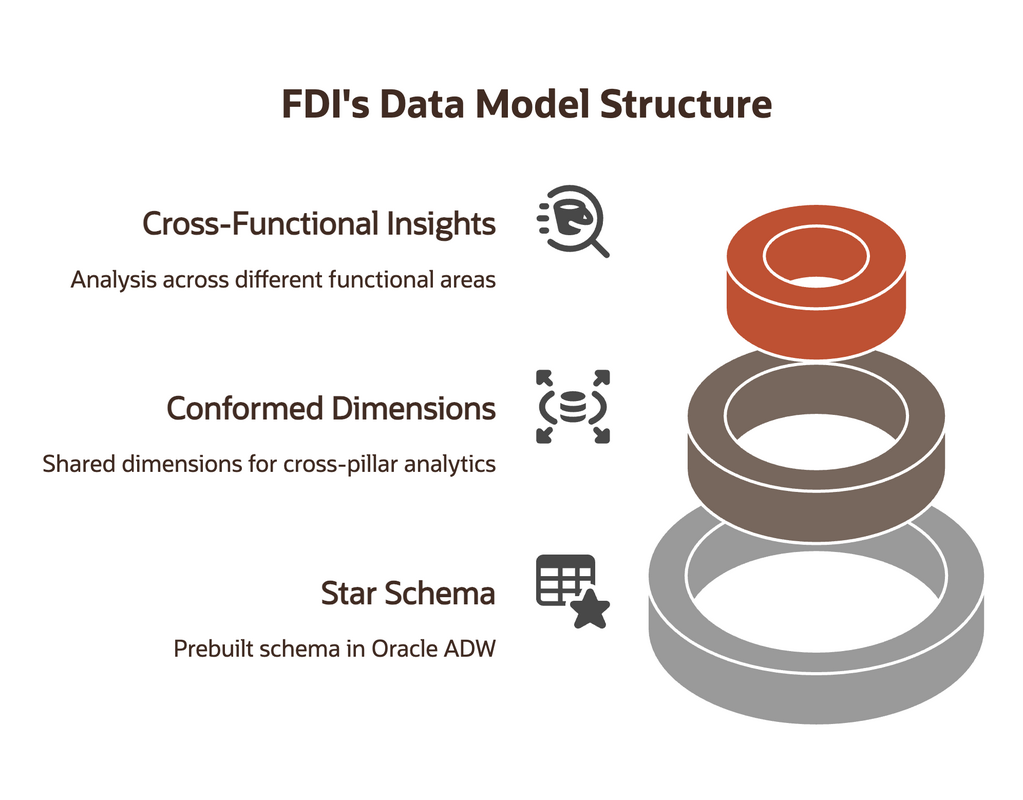
When FDI is provisioned, Oracle automatically creates a prebuilt star schema in ADW. This schema includes fact tables and a network of conformed dimensions - shared across multiple functional areas - that serve as the glue for cross-pillar analytics.
Common dimensions include:
- Customer / Common Party – used across AR, AP, SCM and CX for a 360° view of customer interactions
- Supplier – central to procurement and payables
- Product – essential for SCM, finance, and sales analysis
- Fiscal Calendar – shared across financial, HCM, project and supply chain modules
- Business Unit / Ledger – enabling segmentation and consolidated reporting
These shared dimensions enable users to analyse, for example, how procurement spend (SCM) impacts cash flow (finance), or how HR-driven workforce changes correlate with sales performance - a cross-functional insight made possible by a common semantic backbone.
🏗️ Support for External Data & Custom Schemas
FDI doesn’t just ingest Fusion source data - it enables easy integration of external datasets into the same ADW environment. Whether it’s non-Oracle systems, legacy data, purchased data feeds, or even weather information, FDI supports loading external tables into custom schemas that can extend the star schema and semantic model.
This extensibility is key to bridging out-of-the-box analytics with bespoke business insights - enhancing customer segmentation, supplying additional cost drivers to per-product profitability, or blending external KPIs directly alongside Fusion metrics.
🔍 Benefits of the Lakehouse Foundation
- Cross-pillar consistency: Reporting across HR, finance, supply chain and CX benefits from shared dimensions and semantic logic.
- Query performance: ADW’s columnar, parallel engine delivers high performance on aggregated workloads across large datasets.
- Scalability & elasticity: Cloud-native scaling ensures performance keeps pace with data growth—without manual tuning.
- Governance in one place: Shared data model and schema simplify security, data lineage and audit tracking.
✅ Summary
Under the hood, FDI’s star-schema in ADW provides a robust, extensible greenfield analytics foundation. Built on conformed dimensions and a scalable data warehouse, it enables seamless mash-ups of Fusion data with external sources, supporting rich, multi-domain analytics that truly span the enterprise.
5. Semantic Layer & Pre‑Built Metrics
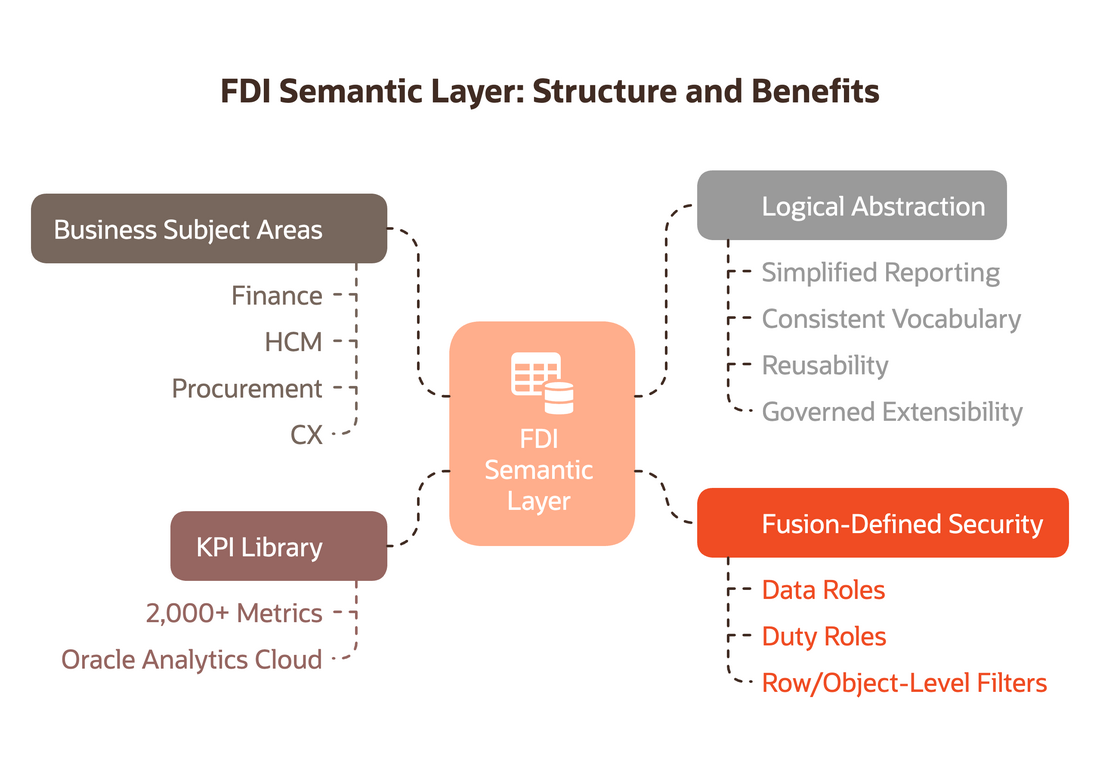
FDI abstracts hundreds of physical tables into logical business subject areas - finance (GL profitability, AP ageing, AR revenue, Trial Balance), HCM (talent acquisition, workforce core), procurement (spend, POs), and CX (campaign ROI, opportunity pipeline) - all underpinned by conformed dimensions. It includes a KPI library with over 2,000 standard metrics, accessible via Oracle Analytics Cloud’s intuitive key-metric editor and drag‑and‑drop visualisations. In essence, this semantic layer creates a unified business vocabulary that simplifies reporting and ensures consistency across the enterprise .
🔐 Complimenting Fusion-Defined Security
FDI leverages Fusion’s built-in role-based security model, so the semantic layer inherits data roles, duty roles, and row/object-level filters defined in Fusion Cloud Applications. Access control is enforced through the Oracle Identity and Access Management (IAM) Service and the FDI Console, ensuring that users only see data they’re authorised to view. This unified approach simplifies administration and compliance by avoiding double entry of security definitions .
🧩 Hiding Complexity Through Logical Abstraction
Rather than exposing raw tables, FDI offers a logical semantic layer that shields users from underlying complexity. Here’s what it achieves:
- Simplified reporting — Subject-area views like “GL Profitability” or “Spend by Supplier” present meaningful business concepts, not table joins.
- Consistent vocabulary — Terms like “Customer”, “Supplier” or “Fiscal Calendar” remain consistent across pillars and dashboards.
- Reusability — Prebuilt key metrics can be used across workbooks and dashboards without redefinition.
- Governed extensibility — Analysts can add custom dimensions or metrics without touching base tables, via semantic extensions that maintain upgrade compatibility .
✅ Summary: User Experience & Governance Wins
| Benefit | Description |
| Business-friendly UX |
Users interact with semantic views, not complex table structures. |
| Aligned metrics |
Same definition of revenue, spend, headcount across all reports. |
| Security-by-design |
Fusion’s security model applies seamlessly across the semantic layer. |
| Safe extensions |
Semantic extensions allow customisation without jeopardising prebuilt content |
Benefit
|
Description
|
Business-friendly UX |
Users interact with semantic views, not complex table structures. |
Aligned metrics |
Same definition of revenue, spend, headcount across all reports. |
Security-by-design |
Fusion’s security model applies seamlessly across the semantic layer. |
Safe extensions |
Semantic extensions allow customisation without jeopardising prebuilt content |
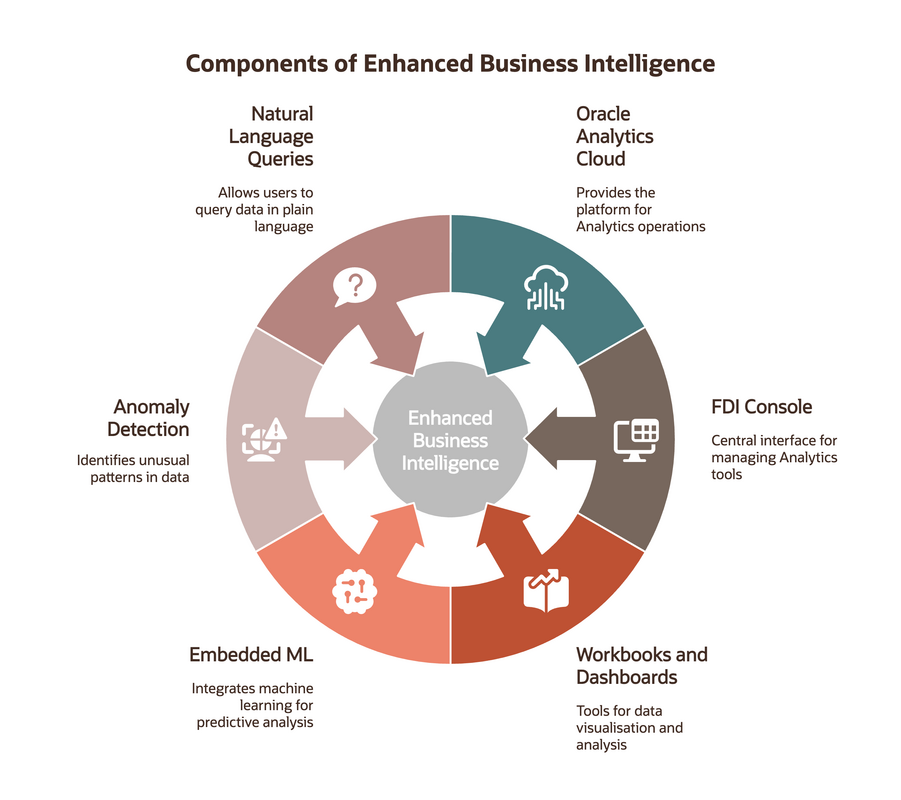
6. Visualisation and Intelligent Dashboards At the heart of Fusion Data Intelligence’s presentation layer is Oracle Analytics Cloud (OAC) - a robust analytics platform that delivers pre‑built dashboards, workbooks, visualisations, and natural‑language queries right out of the box. These are tightly embedded into the FDI ecosystem, enabling immediate use of richly designed visuals without the need for manual development. 📦 Out‑of‑the‑Box Dashboards & Catalog Extensibility FDI comes with a comprehensive set of functional dashboards tailored to key business areas - such as GL profitability, workforce analytics, procurement spend, and campaign ROI. These are readily available via the OAC catalog, simplifying discovery and speeding up time to insight. Moreover, the catalog supports extensibility - you can add new dashboards, visualisations or analytics modules to the catalog, making them available organisation-wide once published. 🛠 Self-Service Data Exploration & Ad Hoc Analytics Beyond consuming pre-built content, OAC empowers users to bring in their own datasets - whether spreadsheets, CSVs or other database connections - for ad hoc querying and analysis. Business users can combine external datasets with FDI’s semantic model, build bespoke workbooks, and share insights - all without requiring IT support. This self-service capability eliminates bottlenecks and fosters data-driven creativity. 🤖 Embedded AI & ML Capabilities OAC also delivers built-in AI and Machine Learning features, including: AI Assistant, that opens up access to insights by natural language querying and a Large Language Model. Auto‑insights, which automatically surface notable trends and anomalies; Natural‑language querying, allowing users to ask questions conversationally; Access to OCI AI services and Oracle Machine Learning (OML) for in‑platform predictive analytics and custom AI model execution. This extends FDI beyond static reporting to an intelligent, self-optimising analytics system. ✅ Why This Matters
| Capability | Value Delivered |
| Immediate Value | Pre-built dashboards reduce time to insight. |
| Discoverable & Extendable | The OAC catalogue allows cataloguing and publishing of new content across teams. |
| Empowered Users | Self-service analytics removes IT dependency and encourages exploration. |
| AI-Powered Insights | Auto-insights and natural-language queries bring intelligence to every user. |
| Actionable Intelligence |
Embedded intelligent apps provide signals with recommended next steps. |
Capability
|
Value Delivered
|
Immediate Value
|
Pre-built dashboards reduce time to insight. |
Discoverable & Extendable
|
The OAC catalogue allows cataloguing and publishing of new content across teams. |
Empowered Users
|
Self-service analytics removes IT dependency and encourages exploration. |
AI-Powered Insights
|
Auto-insights and natural-language queries bring intelligence to every user. |
Actionable Intelligence |
Embedded intelligent apps provide signals with recommended next steps. |
7. Governance, Security & Lineage
Fusion Data Intelligence isn’t just about delivering insights - it’s built on a robust foundation of security governance and data lineage that brings trust, safety, and compliance to the analytics lifecycle.
🔐 Security Inherited from Fusion & Managed via OCI IAM
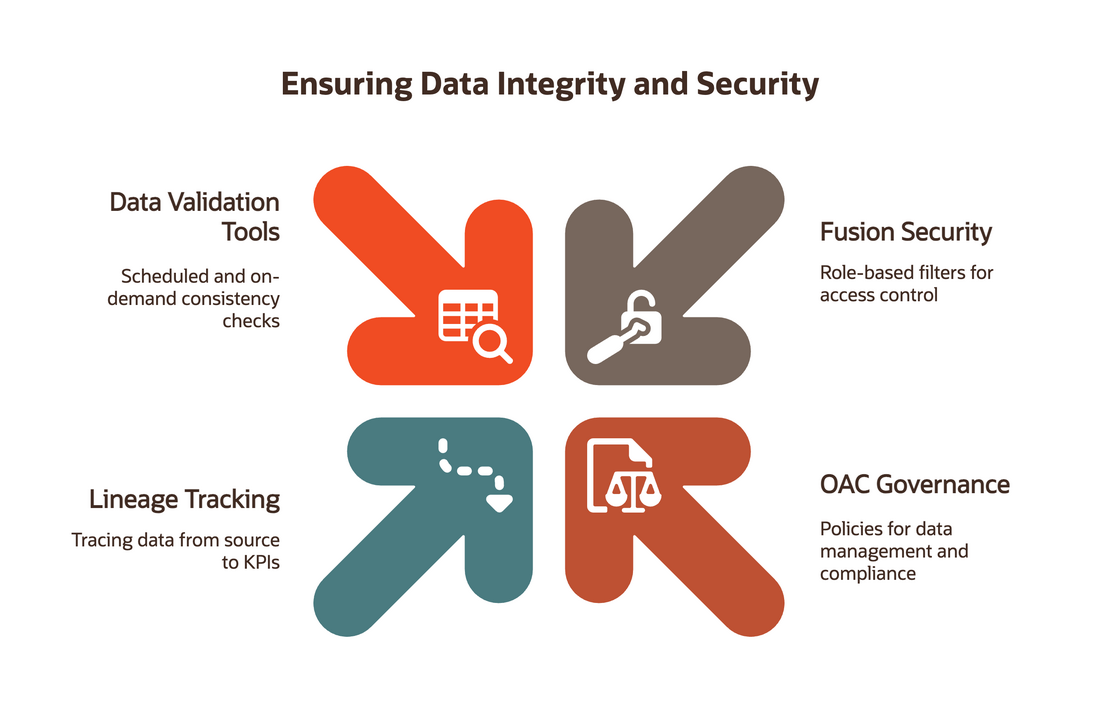
FDI inherits its security framework directly from Fusion Cloud Applications. Role-based access, including data roles and duty roles configured in Fusion, are seamlessly enforced within the FDI semantic layer and Autonomous Data Warehouse (ADW). This ensures that users can access only the data they are authorised to see - without duplicating access definitions in multiple systems.
User and group management within FDI is handled through OCI’s Identity and Access Management Service (IAM). You can sync your Fusion App users and roles into OCI IAM or manage them natively via OCI, and then assign access through system and job-specific groups tailored to FDI. This 1:1 mapping ensures governance is inherited and consistent across both transactional and analytics layers.
Oracle also manages infrastructure-level security - covering upgrades, patching, encryption, IAM policy enforcement, key management, and auditing - helping to maintain compliance and relieve the operational burden on your team.
🧭 Data Lineage & Quality Built-In
Trusted analytics demand transparency - and FDI delivers that through built-in data lineage and validation mechanisms. The system tracks the flow of data from source tables in Fusion Apps, through ingestion pipelines, into curated star schemas, and finally into Semantic Layer metrics and dashboards.
Fusion SCM Analytics documentation provides end‑to‑end lineage spreadsheets that detail column‑ and table-level mappings, making it easy to trace every KPI back to its source fields. You can also monitor pipeline activity in the FDI Console, which records execution timestamps, row counts, and error logs - providing a clear audit trail of data loads and transformations.
Further, FDI includes validation metrics that reconcile data loaded into ADW against transactional data in Fusion. These can be scheduled or run on‑demand, with reports surfaced directly in OAC - making it easy to identify data drift or discrepancies and swiftly pinpoint areas for correction
✅ Summary: Trust, Safety, and Compliance
| Dimension | Feature | Benefit |
| Security | Inherited Fusion roles, OCI IAM management |
No duplication—consistent access enforcement |
| Governance | Encryption, patching, and audit via Oracle-managed OCI stack | Reduced admin overhead and compliance risk |
| Lineage | Column-level mappings and pipeline logs |
Traceability from source to dashboard |
| Data Quality | Built-in validation jobs & reconciliation workbooks |
Confidence in data accuracy and integrity |
Dimension
|
Feature
|
Benefit
|
Security
|
Inherited Fusion roles, OCI IAM management |
No duplication—consistent access enforcement |
Governance
|
Encryption, patching, and audit via Oracle-managed OCI stack
|
Reduced admin overhead and compliance risk |
Lineage
|
Column-level mappings and pipeline logs |
Traceability from source to dashboard |
Data Quality
|
Built-in validation jobs & reconciliation workbooks |
Confidence in data accuracy and integrity |
8. Why This Architecture Matters for Organisations 🚀
Fusion Data Intelligence goes far beyond traditional BI. It sits at the heart of Oracle’s broader Data Intelligence Platform, delivering a unified, 360° view across all enterprise data—transactional, analytical, structured, and unstructured .
🌟 A Unified Data-Intelligence Ecosystem
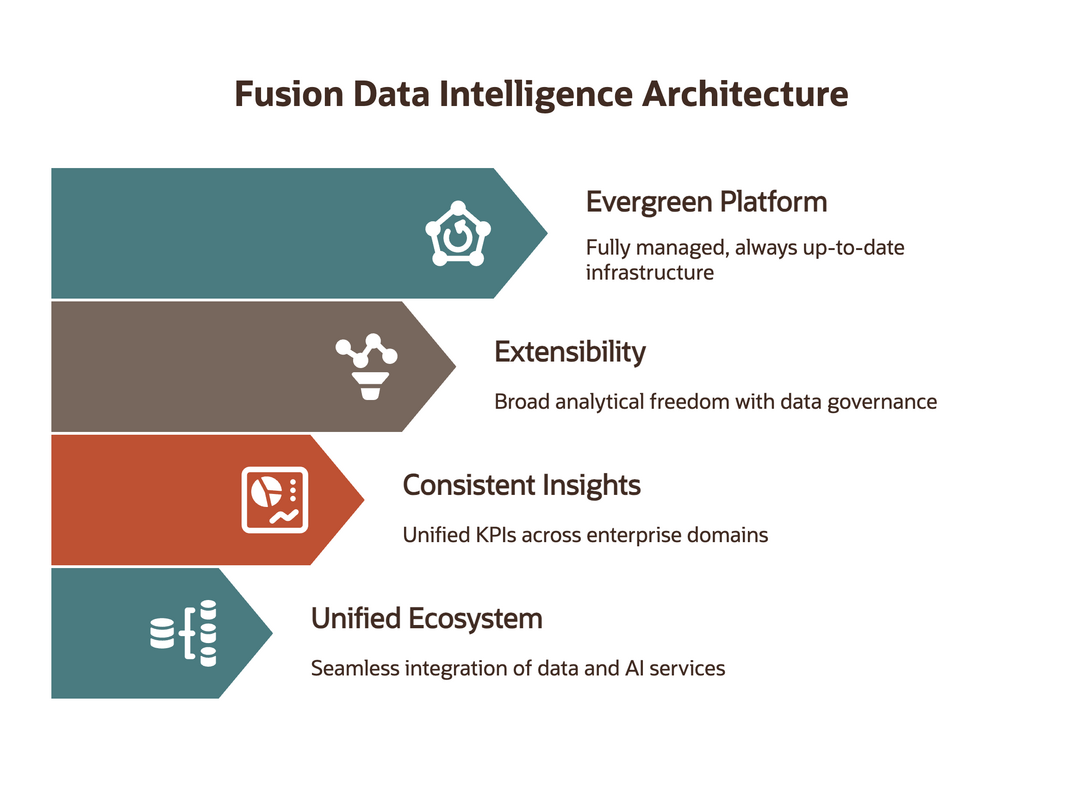
Unlike legacy stacks - OBIA, ODI, siloed data centres - FDI is built on Oracle’s next-generation Data Intelligence Platform. It blends data lakes, Autonomous Data Warehouse, Oracle Analytics Cloud, OCI AI services, and GoldenGate streaming into a seamless, managed ecosystem . This means organisations can now handle batch and real-time data, include external sources and apply AI/ML—all within one secure environment.
This is Oracle's vision as Data Intelligence Platform has been announced but is not yet generally available.
🔄 Consistent Insights Across Pillars
FDI’s architecture supports conformed dimensions and shared semantic models spanning finance, HR, SCM, and CX. This allows for unified KPIs and analytics, enabling stakeholders to ask and answer cross-domain questions like:
- “How is workforce turnover impacting revenue?”
- “What supply chain inefficiencies are driving higher costs?”
The result is enterprise-wide analytics based on a single source of truth .
💡 Full Extensibility with Governed Access
As part of Oracle’s Data Intelligence Platform, FDI offers extensive extensibility. Users can bring in external datasets, extend semantic models, build custom analytics, and consume OCI AI services - all within Oracle’s security framework. Governed self-service means broad analytical freedom without compromising data integrity .
🛠 Evergreen Platform, Zero Infrastructure Burden
The platform is fully managed and evergreen. Oracle handles everything - from provisioning, patching, tuning, and upgrades to integrating the latest AI services. Teams can focus on driving value rather than
wrestling with infrastructure .
🎯 Summary: Strategic Differentiators
| Capability | Benefit |
| 360° Data Integration |
Unified platform for Fusion, external, structured/unstructured data |
| Cross-domain analytic |
Shared metrics enable enterprise-wide decision support |
| AI + embedded actions |
From insights to intervention with intelligent apps |
| Extensible & secure |
Custom analytics and models within governed environment |
| Zero‑touch management |
SaaS simplicity with no technical debt or manual upgrades |
Capability
|
Benefit
|
360° Data Integration |
Unified platform for Fusion, external, structured/unstructured data |
Cross-domain analytic |
Shared metrics enable enterprise-wide decision support |
AI + embedded actions |
From insights to intervention with intelligent apps |
Extensible & secure |
Custom analytics and models within governed environment |
Zero‑touch management |
SaaS simplicity with no technical debt or manual upgrades |
As you’ve seen, Fusion Data Intelligence delivers a fully managed, cloud-native analytics ecosystem - bringing together Fusion SaaS, Oracle’s Autonomous Data Warehouse, and Analytics Cloud under one secure, AI-enhanced platform. It unifies data across domains, embeds intelligent insights and governance, and eliminates legacy complexity - truly delivering on Oracle’s vision of a Data Intelligence Platform. Now it’s your turn: take a moment to reflect on how FDI could accelerate insight‑driven transformation in your organisation.